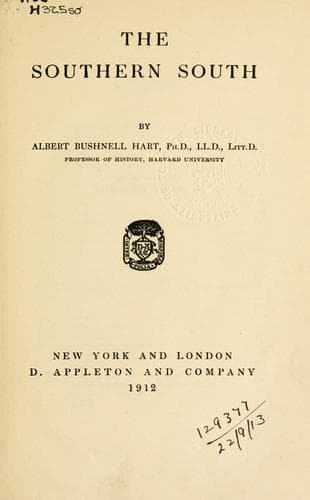
Southern States -- Social conditions; United States -- Race relations
One of the worst criminal cases of this kind is that of John W. Pace, of
Dade City, Ala., who not only shut in his own people, but would seize any
black that chanced along that way and compel him to work for him a few
days. Judge Thomas G. Jones, who in 1901 was put on the federal bench in
that state, made it his business to follow up Pace; when a jury declined
to convict him, the judge rated them soundly; another case was made out
and Pace thought it prudent to plead guilty, and was sentenced to
fifty-five years in the penitentiary. The Supreme Court of the United
States affirmed the constitutionality of the peonage law and Pace threw up
his hands; then, on the request of the judge, the President pardoned him.
These and some like convictions have shaken the system of confining men
because the employer thinks that otherwise they will go away.
Nevertheless, under cover of iniquitous state laws, peonage of Negroes
goes on steadily, first by a most unjust enforcement of various special
state statutes which require agricultural labor contracts to be made in
writing, and to run for a year. The illiterate Negro often does not know
what he is signing, and if he did know might see no means of helping
himself. It is difficult to contrive a legal penalty for a Negro who
simply leaves his contract and goes off; he might be arrested and held for
debt, since almost all such hands owe their employer for supplies or
money; but all the Southern states have constitutional provisions against
imprisonment for debt. The difficulty is ingeniously avoided by most of
the states in the Lower South, which make it a punishable offense to draw
advances on "false pretenses"; thereby a hand who attempts to leave while
in debt to his master can be arrested as a petty criminal. But how is it
provable that the Negro might not intend to return and carry out his
contract? In Alabama the legislature, with intent to avoid the federal
peonage law, has provided that the acceptance of an advance and the
subsequent nonperformance of the contract shall be proof presumptive of
fraudulent intent _at the time of making the contract_. Now the employer
can follow his absconding hand by a process thus described by a planter.
You arrest him on the criminal charge of false pretenses, which is
equivalent to a charge of stealing the money; you get him convicted; he is
fined, and in lieu of money to pay the fine he goes to jail; then you pay
the fine and costs and the judge assigns him to you to work out the fine,
and you have him back on your plantation, backed up by the authority of
the state.
Public-domain text, read in full here on John Shaqi.
Reviews
Reviews
No reviews yet
Be the first to share your thoughts on this work.
Elsewhere in the archive
Join the Discussion
Join the discussion
Sign in to leave a comment or review.
Sign InorCreate an account