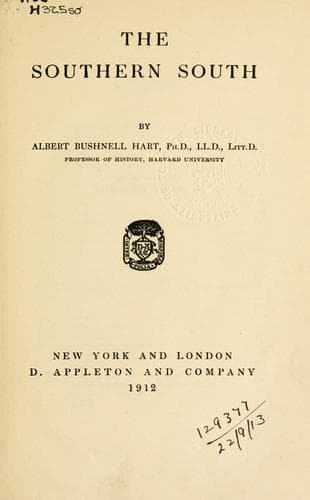
Southern States -- Social conditions; United States -- Race relations
Most people suppose that negro education began during the Civil War, but
it is as old as colonization; free Negroes were always allowed some
privileges in this respect, and thousands of slaves were taught to read by
kind-hearted mistresses and children of the family; the opinion of one who
has carefully explored this field of inquiry is that of the adult slaves,
about one in ten could read and write. Nevertheless, this practice was
contrary to the principles and the laws of the South, as is proved by the
dramatic prosecution of Mrs. Margaret Douglass, of Norfolk, in 1853, for
the crime of holding a school for free negro children, in ignorance of the
fact that it was forbidden as "against the peace and dignity of the
Commonwealth of Virginia." In due time this person, who had admitted
unhallowed light into little dark souls, was duly sentenced to thirty
days' imprisonment, a penalty (as the judge explained) intended to be "as
a terror to those who acknowledge no rule of action but their own evil
will and pleasure."
Both the teachings and the prosecutions establish a general belief that
Negroes could easily learn to read and write; and when during the Civil
War refugees flocked into the Union camps at Beaufort and Hilton Head,
charitably disposed people in the North sent down teachers; and, the
federal government coöperating, schools were started among those Sea
Island people, then rough, uncouth, and not far beyond the savage state,
though now a quiet, well-ordered, and industrious folk. From that time
till the giving up of the Freedman's Bureau in 1869, the federal
government expended some money and took some responsibility for negro
education. It was a pathetic sight to see old gray-headed people crowding
into the schools alongside the children, with the inarticulate feeling
that reading and writing would carry them upward. The Northern missionary
societies kept up these elementary schools, and then began to found
schools and colleges for the training of the most gifted members of the
race. Out of their funds, and with the aid of the freedmen, they put up
schoolhouses, they collected money to establish institutions like Fisk
University in Nashville, Leland and Straight Universities in New Orleans,
and Atlanta University. Such colleges were on the same pattern as other
colleges for Whites both North and South, adopting the then almost
universal curriculum of Greek, Latin, and mathematics, along with
smatterings of other subjects; they included preparatory schools, which,
as in some white colleges both North and South, included the larger number
of the recorded students.
Public-domain text, read in full here on John Shaqi.
Reviews
Reviews
No reviews yet
Be the first to share your thoughts on this work.
Elsewhere in the archive
Join the Discussion
Join the discussion
Sign in to leave a comment or review.
Sign InorCreate an account