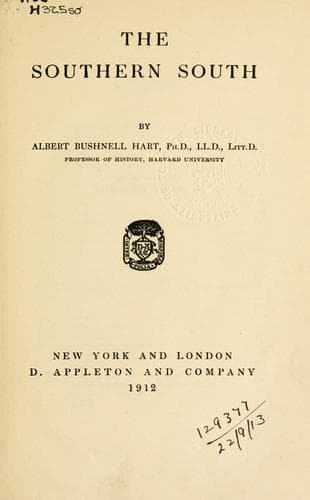
Southern States -- Social conditions; United States -- Race relations
The mere statistics of negro schools and attendance after all carry with
them little information. What kind of pupils are they? What kind of school
buildings are provided for them? What is the character of their teachers?
Naturally, among both races, many are at work after twelve or fourteen
years, but the percentages of enrollment and attendance are so much less
than those of the white people that apparently colored children are less
likely than white to be sent to school and to be kept there when started.
Though every Northern state without exception has some kind of compulsory
education, not a single Southern state, except Kentucky and Missouri, has
enacted it.
Some personal knowledge of Southern schools, both in cities and the
country, suggests several reasons why the attendance is small. Visit this
negro wayside school in the heart of the piney woods near Albany, Ga. The
building is a wretched structure with six glass windows, some of them
broken; the sky visible between the weatherboards. There is one desk in
the room, the teacher's, made of rough planks; the floor is rough and
uneven. Of the forty-four children enrolled, none of whom come more than
about three miles, thirty-two are present on a pleasant day; six of them
appear to be mulattoes. They wear shoes and stockings and are quiet and
well-behaved but sit in the midst of dirt on dirty benches. The teacher is
a pleasant woman, wife of a well-to-do colored man in the neighboring
town, but apparently untrained. She teaches five months at $35 a month.
Last year there was no school at all in this district.
Enter another school at Oak Grove, Ala. The house is a single room,
twenty-five feet square; larger than is needed, like many of the
schoolhouses, because it may serve also for church services. There is not
a sash in any one of the seven windows, each having a hinged shutter. The
teacher has a table, and for the pupils are provided several rude benches
with or without backs; the room is furnished with a blackboard and is
reasonably clean; the teacher, a young man eager and civil, a graduate of
a neighboring school carried on by the Negroes for themselves, holds five
months' school. Take another school near Albany, Ga., in a tolerably good
schoolhouse built by the Negroes themselves with some white assistance,
for the county commissioners will do no more than offer $100 to a district
that will spend about $300 more on a building. The room overcrowded, four
or five at a desk; twice as many girls as boys; a good teacher who has had
some normal training; a book for each group of three in the reading class;
the lesson about a brutal Yankee officer who compels a little Southern
girl to tell where the Confederate officer is hiding. The children read
well and with expression.
Public-domain text, read in full here on John Shaqi.
Reviews
Reviews
No reviews yet
Be the first to share your thoughts on this work.
Elsewhere in the archive
Join the Discussion
Join the discussion
Sign in to leave a comment or review.
Sign InorCreate an account