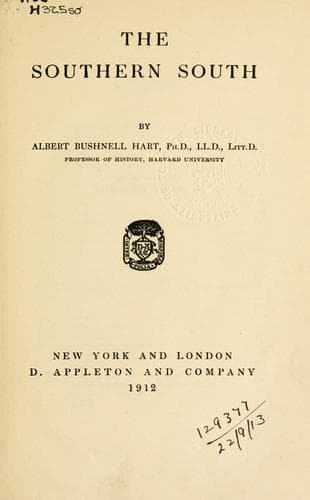
Southern States -- Social conditions; United States -- Race relations
The Northern schools for the education of the Negroes have brought about
one of the unpleasant features of the Southern question in the boycotting
of the Northern teachers, both men and women, who have come down to teach
them. This practice is a tradition from Reconstruction times when it was
supposed that the Northern teachers were training colored youth to assert
themselves against Whites. They expected only to furnish examples and
incitements to the Southern people themselves; hence a feeling of
bewilderment and grief, because from the very beginning the white teachers
in these institutions have been under a social ban the relentlessness of
which it is hard for a Northerner to believe. An educated and cultivated
white family has lived in a Southern city, superior intellectually and
morally to most of the community about it; yet no friendly foot ever
crossed its threshold. The beautiful daughter, easily first in the girls'
high school, never exchanged a word with her classmates outside the
school, except when called upon, as she regularly was, to help out her
less gifted fellows, as an unpaid and unthanked tutor--because her father
was spending his life in trying to uplift the Negro. The attitude of the
South toward most of those schools is one of absolute hostility. Even an
institution so favorably regarded in the South as Hampton Institute has
been prohibited by the Legislature of Virginia (which makes it a small
money grant) from selling the products of its industrial department.
The negro colleges in the South are far from prosperous; planted in the
day of small things with limited endowments, frequented by people who have
little money to pay for tuition, they have been supported from year to
year by Northern gifts which are not sufficient to keep them up to modern
demands. Though some of them have tolerable buildings, few have adequate
libraries, laboratories, or staff of specialist instructors. The state
institutions of this grade open to blacks are nearly all rather low in
standards, and offer little inducement for academic training; they are
either normal or industrial in type. The better off of the Negroes send
their sons to Northern white colleges where they may receive the best
instruction but have little contact with their fellow students. So far
from the number of negro college graduates being too great, it is entirely
too small for the immediate needs of the race. They must have educated
teachers and trained professional men; the negro schools will never
flourish without competent teachers and supervisors of the negro race. In
many respects the colleges are the weakest part of negro education. One
school in which numbers have had good training, Berea College, Kentucky,
has now been abandoned under an act of the state legislature forbidding
the teaching of Whites and Negroes together, but an industrial school of
high grade will be provided exclusively for the colored race.
Public-domain text, read in full here on John Shaqi.
Reviews
Reviews
No reviews yet
Be the first to share your thoughts on this work.
Elsewhere in the archive
Join the Discussion
Join the discussion
Sign in to leave a comment or review.
Sign InorCreate an account