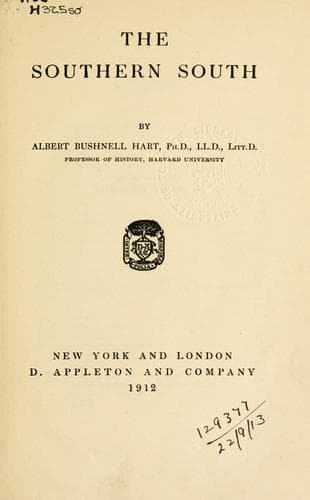
Southern States -- Social conditions; United States -- Race relations
Outside of newspapers the Negroes have access to the written works of
members of their own race, which are at the same time a proof of literary
capacity and a means of teaching the people. Of course it is always urged
that such men as Booker Washington, the educator and uplifter; Dunbar, the
pathetic humorist; Chesnutt, author of stories of Southern life that rival
Joel Chandler Harris and Thomas Nelson Page; DuBois, who in literary power
is one of the most notable Americans of this generation; Kelly Miller, the
keen satirist; and Sinclair, the defender of his people--prove nothing as
to the genius of the races because they are mulattoes; but they and their
associates are listed among the Negroes, included in the censure on negro
colleges, and furnish the most powerful argument for the education of at
least a part of the race. Few men of genius among the Negroes are pure
blacks; but it is not true that the lighter the color the more genius they
possess. So far as the effects of a prolonged and thorough education are
concerned, those men from any point of view prove that the mulattoes, who
are perhaps a fifth of the whole, are entitled to a thorough education.
Has not DuBois the right to say:
"I sit with Shakespeare and he winces not. Across the color line I move
arm in arm with Balzac and Dumas, where smiling men and welcoming women
glide in gilded halls. From out the caves of evening that swing between
the strong-limbed earth and the tracery of the stars, I summon Aristotle
and Aurelius and what soul I will, and they come all graciously with no
scorn nor condescension. So, wed with Truth, I dwell above the Veil. Is
this the life you grudge us, O knightly America? Is this the life you long
to change into the dull red hideousness of Georgia? Are you so afraid lest
peering from this high Pisgah, between Philistine and Amalekite, we sight
the Promised Land?"
On the other hand, the history of the last thirty-five years proves
conclusively that the great mass of negro children can assimilate the
ordinary education of the common schools. Mr. Glenn, recently
Superintendent of Education in Georgia, declares that "the negro is ...
teachable and susceptible to the same kind of mental improvement
characteristic to any other race," and Thomas Nelson Page admits that the
"Negro may individually attain a fair, and in uncommon instances a
considerable degree, of mental development." About three fourths of the
young people have already learned to read.
Public-domain text, read in full here on John Shaqi.
Reviews
Reviews
No reviews yet
Be the first to share your thoughts on this work.
Elsewhere in the archive
Join the Discussion
Join the discussion
Sign in to leave a comment or review.
Sign InorCreate an account