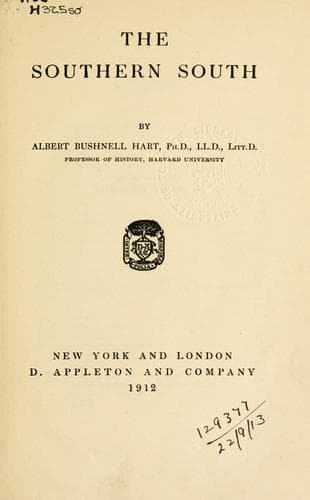
Southern States -- Social conditions; United States -- Race relations
ranked as taking a college course are comparatively few.
These figures throw light on the further conventional belief that it is
the Northern endowed colleges that have made the trouble in the colored
race, through efforts to teach the colored youth that they were the equals
of the Whites. By far the greater number of Negroes who are really getting
training above the secondary grade in the South are in the state-sustained
institutions--many of them, of course, still of low grade; and full credit
should be given to the South for developing this type of negro education,
of which the North knows little. State Agricultural, Normal or Industrial
colleges are to be found in every former slaveholding state, except
Arkansas and Tennessee, and together include more than 5,000 students.
The attacks, chiefly from Southern Whites, upon negro college education
have of late been transformed into a controversy as to the relative
importance of academic and industrial training. The schools of the
Tuskegee type furnished manual work to their students apparently not in
the first instance because it was thought to be educative, but because
they had to earn part of their living. This is apparently the main source
of the bitter hostility of Dixon to the work of Tuskegee. The form his
criticism takes is that Booker Washington, instead of teaching the Negro
to be a good workman, is training him to take independent responsibility;
that if he is a good workman he will compete with the Whites, and if he is
a good leader he will aim to make the Negroes a force in the community.
This line of objection to education of the black is really based upon the
belief that they are a race capable of education, that the Negro is not a
clod, but may be improved by the systematic efforts of superior men; he
has in him the potentiality of vital force.
Meanwhile throughout the country has been running a current in favor of a
more practical education than that furnished by the ordinary schools, and
the result has been the Technical, Manual Training, and Commercial schools
scattered throughout the Northern states. The controversy is not at all
confined to questions of negro education. The Southern white people have
been well inclined toward the new type of education for Negroes, although
on the whole much preferring the academic type for their own children.
Public-domain text, read in full here on John Shaqi.
Reviews
Reviews
No reviews yet
Be the first to share your thoughts on this work.
Elsewhere in the archive
Join the Discussion
Join the discussion
Sign in to leave a comment or review.
Sign InorCreate an account