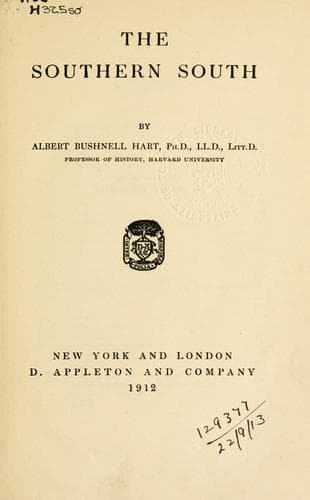
Southern States -- Social conditions; United States -- Race relations
(I) The first is the dominance of the white race, which will not surrender
any of the present privileges. As Page puts it: "The absolute and
unchangeable superiority of the white race--a superiority, it appears to
him, not due to any mere adventitious circumstances, such as superior
educational and other advantages during some centuries, but an inherent
and essential superiority, based on superior intellect, virtue, and
constancy. He does not believe that the Negro is the equal of the White,
or ever could be the equal." That means that the low Negro is inferior to
the low White, the average Negro to the average White, and the superior
Negro, however high his plane, moral and intellectual, is also to be put
into a position of permanent inferiority to the higher Whites. Because
inferior morally and mentally, he is held also in political inferiority.
The South does not intend that even intelligent and educated Negroes shall
have a share in making or administering the laws.
(II) Partly from a sense of its own superiority, partly from a disdain of
a formerly servile race, chiefly from a well-founded belief that
amalgamation would be a great misfortune for the community, the South is
determined that there shall be no legalized admixture of the races. That
miscegenation is still going on in an unknown degree heightens the
determination that it shall at least be put under the ban of law; the very
danger makes the South more determined that the races shall be kept
separate.
(III) The dominant white Southerners are further absolutely determined
that any settlement of the question shall come from their volition; and
that means that the Southern Negro is not expected to exercise anything
more than a mild academic influence. The character of the Negroes, their
thriftlessness or industry, their crime or virtue, their stupidity or
their intelligence, may deflect the white mind one way or another; their
preferences, outside the iron fence which the South has erected round the
question, will receive some attention; but they will have to accept what
the white people assign to them.
(IV) The South is as yet little awakened to the idea that the status of
the lower Whites is a part of the whole race problem. Inasmuch as the Poor
White is emerging from seclusion and poverty, people do not sufficiently
realize that he needs education, intellectual and moral; that his
passions, his animal instincts, his violence stand in the way of the
uplift of both races.
(V) The North is expected by the South not to act by legislation or any
other active method in behalf of the Negro. The Southerners in general
consider the Fifteenth, or suffrage Amendment, to be an affront, which
they avoid by shifty clauses in their constitutions and would repeal if
they could. Some Southerners resent even inquiry about the South, and
apparently remember how their fathers received visiting abolitionists.
Public-domain text, read in full here on John Shaqi.
Reviews
Reviews
No reviews yet
Be the first to share your thoughts on this work.
Elsewhere in the archive
Join the Discussion
Join the discussion
Sign in to leave a comment or review.
Sign InorCreate an account