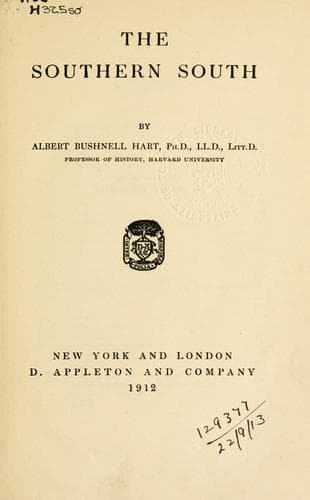
Southern States -- Social conditions; United States -- Race relations
First of all, can the Southern race question be solved by any action of
the North? The Reconstruction amendments with the clause authorizing
Congress to enforce them by "appropriate legislation" seem intended to
give the federal government power to protect the Negro against either
state legislation or individual action; but the Supreme Court in the Civil
Rights decision of 1883 held that the action of Congress under those
amendments was confined to meeting positive official action by state
governments. The Fourteenth Amendment provides for a special penalty in
case of deprivation of political rights, by reducing the representation in
Congress of the states which limit their suffrage. Any such legislation
must be general in terms and would therefore apply to the Northern states
in which there are educational or tax qualifications. Beyond that
difficulty is the remembered ill effect of Reconstruction laws, and the
conviction in the North that the negro problem is not one simply of race
hostility and definition of rights--that the Negroes are in many ways a
menace. To take the matter a second time out of the hands of the people on
the ground, even though they are not solving their own problems, would
mean a storm in Congress, a weight on the administration, possibly a
contest with the Supreme Court, which no responsible Northern public man
likes to contemplate.
Through the control of Congress over federal elections there is another
opportunity to interfere in behalf of the Negro, but the federal laws put
on the statute book in Reconstruction times were repealed in 1894; and
nobody now proposes to renew them. By the recent experience of the nation
in the Philippines, Porto Rico, and Cuba, a lesson has been taught of the
difficulty of handling non-European races. The nation begins to doubt the
elevating power of self-government. For whatever reason, there is no
evidence of any intention in the North to make the Negro the ward of the
nation. The writer is one of those who believe that any general federal
legislation would revive friction between the sections, would sharpen the
race feeling in the South, and in the end could accomplish little for the
uplift of the Negro; even federal aid to education could hardly be so
managed as to keep up the feeling of white responsibility from which alone
proper education of the Negro can be expected.
Public-domain text, read in full here on John Shaqi.
Reviews
Reviews
No reviews yet
Be the first to share your thoughts on this work.
Elsewhere in the archive
Join the Discussion
Join the discussion
Sign in to leave a comment or review.
Sign InorCreate an account