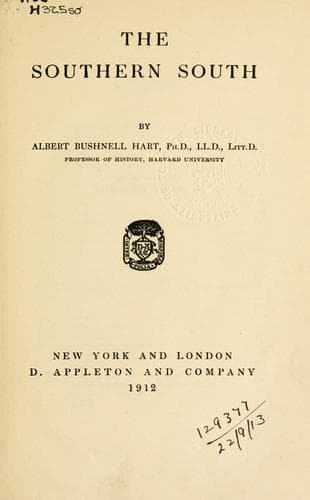
Southern States -- Social conditions; United States -- Race relations
In other parts of the country where there are such rivalries, efforts are
made to come to an understanding. Each side has some knowledge of the
arguments of the other; they appeal to the same press; the leaders sooner
or later are brought together in legislatures or in a social way, and
gradually come to understand each other's difficulties. Some efforts have
been made in the South to study this question in association. The Negroes
have now several organizations which bring people together for discussion.
The Agricultural and Industrial Fairs which they are beginning to carry on
are one such influence. The negro schools of the Calhoun and Talladega
type do something; the large annual conferences organized by Atlanta,
Tuskegee, and Hampton, with their subsequent publications, are a kind of
clearing house of opinions on the conditions of the Negro and of sound
advice. A few years ago the attempt was made in the so-called Niagara
Movement to organize the Negroes in defense of their political rights.
On the side of the Whites there has been the Ogden Movement, for the
improvement of the Southern white education, part of the outcome of which
has been the formation of the General Education Board and Southern
Education Board. The _South Atlantic Quarterly_, published at Trinity
College, North Carolina, encourages a free exchange of views on Southern
conditions; and though the _Manufacturers' Record_ lays the responsibility
for the Atlanta riots upon the Southern white people who have been urging
moderation in the South, the Southern educational movement goes on
steadily, and seems to be gaining ground.
An effort was made after the riots to bring about a Southern commission of
three white men from each state, to discuss plans for keeping up the race
integrity of the Whites, including the Negro to stay on the soil,
educating both races, and reforming the courts, but it was allowed to
fail. Some Southern newspapers bitterly attacked it on the ground that no
discussion was necessary; that everybody knew all the facts that were
cogent, and that any such discussion of the negro problem would be likely
to bring down criticism from "doctrinaires, theorists and self-constituted
proprietors of the universe in the North." To the Northern mind this seems
one of the most alarming things about the whole matter. The labor question
in the Northeast, the land question in the Northwest, are openly discussed
man to man, and newspaper to newspaper. Nobody thinks that the conditions
in the South are agreeable; everybody would like to see some betterment;
and the refusal to discuss it simply makes the crisis worse.
Public-domain text, read in full here on John Shaqi.
Reviews
Reviews
No reviews yet
Be the first to share your thoughts on this work.
Elsewhere in the archive
Join the Discussion
Join the discussion
Sign in to leave a comment or review.
Sign InorCreate an account