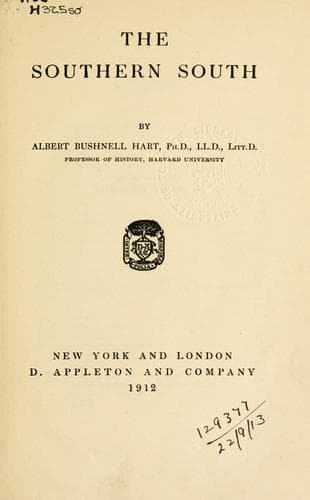
Southern States -- Social conditions; United States -- Race relations
Nobody can work out any of the Caucasian problems as though they stood by
themselves; what now draws together most closely the elements of the white
race is a sense of a race issue. The white man cannot build new
schoolhouses or improve his cotton seed or open a coal mine without
remembering that there is a negro race and a negro problem. This
consciousness of a double existence strikes every visitor and confronts
every investigator. As Du Bois says, the stranger "realizes at last that
silently, resistlessly, the world about flows by him in two great streams:
they ripple on in the same sunshine, they approach and mingle their waters
in seeming carelessness,--then they divide and flow wide apart." Henry W.
Grady asserted that "The race problem casts the only shadow that rests on
the South." Murphy says, "The problems of racial cleavage, like problems
of labor and capital, or the problems of science and religion, yield to no
precise formulæ; they are problems of life, persistent and irreducible."
Various as are the opinions in the South with regard to the race problem
and the modes of its solution, society is infused with a feeling of
uneasiness and responsibility. Sometimes the visitor seems to catch a
feeling of pervading gloom; sometimes he hears the furious and cruel words
of those who would end the problem by putting the Negro out of the
question; sometimes he listens to the hopeful voice of those who expect a
peaceful and a just solution; but all thinking men in the South agree that
their section has a special, a peculiar, a difficult and almost insoluble
problem in which the North has little or no share.
Here comes in the first of many difficulties in dealing with the Southern
question, a diversity of voices such that it is hard to know which speaks
for the South, or where the average sentiment is to be found. Public
opinion on some moral and social questions is less easily concentrated
than in the North; though the prohibitionists have recently made a very
successful campaign through a general league, all efforts to focus public
opinion on the negro question through general societies and public
meetings have so far failed.
Public-domain text, read in full here on John Shaqi.
Reviews
Reviews
No reviews yet
Be the first to share your thoughts on this work.
Join the Discussion
Join the discussion
Sign in to leave a comment or review.
Sign InorCreate an account