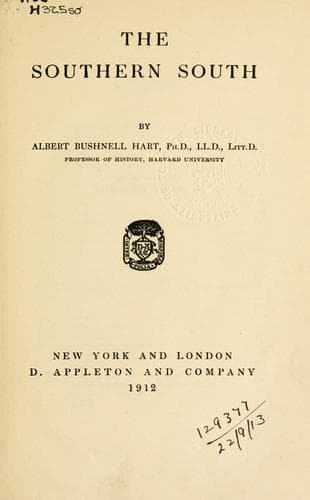
Southern States -- Social conditions; United States -- Race relations
Agitation or even discussion of the race problem is not much aided by the
press, though in some ways journalism is on a higher plane than in the
North. Most cities, even small ones, have a newspaper which is edited with
real literary skill, and which does not seem to be the servant of any
commercial interest. There is a type of Southern paper of which the
_Charleston News and Courier_ is the best example, which has for its
stock-in-trade, ultra and Bourbon sentiments. No paper in the South is
more interesting than the _News and Courier_, but it represents an age
that is past. The conservative, readable, and on the whole, high-toned
Southern newspapers, do not in general seem to lead public sentiment, and
the yellow journal has begun to compete with them. Still the paper which
by its lurid statement of facts, large admixture of lies, and use of
ferocious headlines, was one of the chief agents in bringing about the
Atlanta riots of 1907 afterwards went into the hands of a receiver; and
journals of that type have less influence than in the North.
A temperamental Southern characteristic is an impatience of dissent, a
characteristic which has recently been summed up as follows by a foreigner
who has lived twelve years in the South and is identified with it. "There
are three phases of public sentiment that I must regard as weaknesses, ...
The public attitude of Southern temper is over-sensitive and too easily
resents criticism.... Then, I think the Southern people are too easily
swayed by an apparent public sentiment, the broader and higher conscience
of the people gives way too readily to a tin-pan clamor, the depth and
real force of which they are not disposed to question.... Again, ... the
South as a section, does not seem fully to appreciate the importance of
the inevitables in civilization--the fixed and unalterable laws of
progress." Illustrations of this sensitiveness to criticism are abundant.
For instance, the affectionate girl in the Southern school when a Yankee
teacher gives her a low mark, bursts into tears, and wants to know why the
teacher does not love her.
From slavery days down, there has been a disposition to look upon Northern
writers and visitors with suspicion. Still inquirers are in all parts of
the South received with courtesy by those whose character and interest in
the things that make for the uplift of both the white and the black race
furnish the most convincing argument that there is an enlightened public
sentiment which will work out the Southern problem. In any case there is
no public objection to criticism of Southerners by other Southerners;
nothing, for instance, could be more explicit and mutually unfavorable
than the opinions exchanged between Hoke Smith and Clark Howells in 1907,
when rival candidates for the governorship of Georgia. In politics one may
say what he likes, subject to an occasional rebuke from the revolver's
mouth.
Public-domain text, read in full here on John Shaqi.
Reviews
Reviews
No reviews yet
Be the first to share your thoughts on this work.
Join the Discussion
Join the discussion
Sign in to leave a comment or review.
Sign InorCreate an account