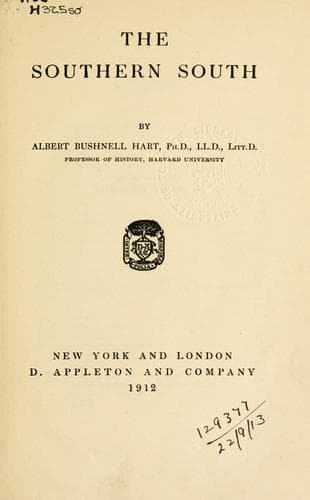
Southern States -- Social conditions; United States -- Race relations
This system was assumed to be especially happy for the slave; witness a
recent Southern writer: "Hence, to the negro, the institution of slavery,
so far from being prejudicial, was actually beneficial in its effects, in
that, as a strictly paternal form of government, it furnished that
combination of wise control and kind compulsion which is absolutely
essential to his development and well-being." Minor, in his recent "The
Real Lincoln," urges that "the children of slaveholders may be saved from
being betrayed into the error of regarding with reprobation the conduct of
their parents in holding slaves"; and justifies slavery on the ground that
the slaves had "a more liberal supply of the necessaries of life than was
ever granted to any other laboring class in any other place, or other
age." Reed, in his "Brothers' War," holds that "Any and every evil of
southern slavery to the negro was accidental.... Slavery, so far from
being wrong morally, was righteousness, justice, and mercy to the slave."
No wonder that "Nicholas Worth" exclaims: "What I discovered was that the
people did not know their own history; that they had accepted certain
oft-repeated expressions about it as facts; and that the practical denial
of free discussion of certain subjects had deadened research and even
curiosity to know the truth."
This theory that slavery was harmful, if harmful at all, only to the white
race, has gone to the extent of insisting that slavery was educational;
thus Thomas Nelson Page says that at the end of the War, among the
able-bodied Negroes there was "scarcely an adult who was not a trained
laborer or a skilled artisan. In the cotton section they knew how to raise
and prepare cotton; in the sugar belt they knew how to grow and grind
sugar; in the tobacco, corn, wheat, and hay belts they knew how to raise
and prepare for market those crops. They were the shepherds, cattle-men,
horse-trainers and raisers. The entire industrial work of the South was
performed by them.... Nearly all the houses in the South were built by
them. They manufactured most of the articles that were manufactured in the
South." And Mrs. Avary, in her "Dixie After the War," thinks that "the
typical Southern plantation was, in effect, a great social settlement for
the uplift of Africans." These arguments are perhaps not intended to
suggest that the present free laboring population would be better off if
reduced to slavery; but they fix upon the present generation the unhappy
task of justifying all the mistakes of previous generations.
Public-domain text, read in full here on John Shaqi.
Reviews
Reviews
No reviews yet
Be the first to share your thoughts on this work.
Elsewhere in the archive
Join the Discussion
Join the discussion
Sign in to leave a comment or review.
Sign InorCreate an account