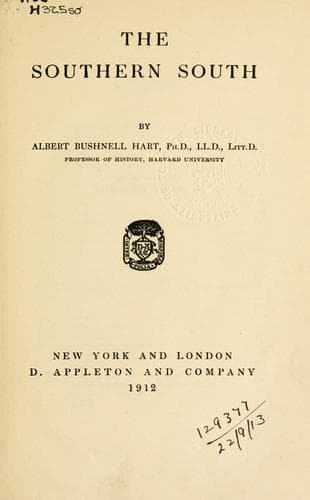
Southern States -- Social conditions; United States -- Race relations
The natural and wholly justifiable pride in the military spirit of the
South during the Civil War extends over to the constitutional, or rather
psychical, question of Secession. No issue in the world is deader than the
question whether states have a right to secede, for the simple reason that
the experience of forty years ago shows that in case any state or group of
states hereafter may wish to secede, the other states will infallibly
combine to resist by military force: no state or section can ever again
assert that it has reason to suppose that secession is a peaceful and
constitutional remedy, which should be accepted quietly by the sister
states. To justify the doctrine of secession now would mean to pull out
the bracing of the Union, no part of which is more determined to be a
portion of one great and powerful American nation than the Southern
States. It can hardly be expected that the North, after sacrificing five
hundred thousand lives and four billions of treasure, will, half a century
later, come round to the point of view of the defeated section.
It is equally idle at this period of the world's history to deny to the
Southern leaders in the Civil War sincerity and courage, or to withhold
from the nation the credit of such lofty characters as Lee and Stonewall
Jackson; but if they are to become world heroes alongside of Cromwell and
Iredell, consistency demands that the corresponding Northern leaders shall
likewise be accepted as sincere and courageous, and in addition as
standing for those permanent national principles to which the children of
their adversaries have now given allegiance. It is discouraging to
discover such a book as Charles L. C. Minor's "The Real Lincoln; from the
Testimony of his Contemporaries," which has gone to a second edition and
the purpose of which is, by quoting the harsh and cruel things said of
Lincoln in the North during his lifetime, to show that he was weak, bad,
and demoralized. Far more modern the testimony of Grady in his New York
speech of 1886, when he referred to him "who stands as the first typical
American, the first who comprehended within himself all the strength and
gentleness, all the majesty and grace of this republic--Abraham Lincoln.
He was the sum of Puritan and Cavalier; for in his ardent nature were
fused the virtues of both, and in the depths of his great soul the faults
of both were lost. He was greater than Puritan, greater than Cavalier, in
that he was American."
Public-domain text, read in full here on John Shaqi.
Reviews
Reviews
No reviews yet
Be the first to share your thoughts on this work.
Elsewhere in the archive
Join the Discussion
Join the discussion
Sign in to leave a comment or review.
Sign InorCreate an account