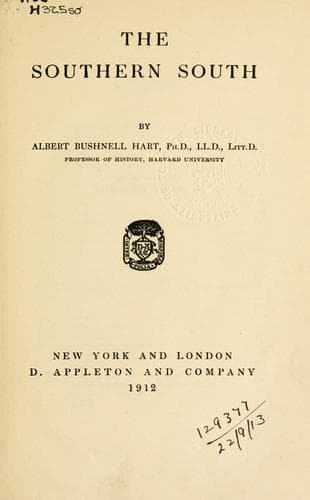
Southern States -- Social conditions; United States -- Race relations
Both the duration and the intensity of the Reconstruction process have
been overestimated. It was a period of general disorganization; the time
of the Credit Mobilier scandals; the exact decade when the people of New
York City were paying eighty million dollars for the privilege of being
plundered by Boss Tweed. The Southern state governments had previously
been economically administered, and the people keenly felt the degradation
of corruption from which Northern States were also suffering; but the
actual period of Reconstruction was much shorter than has usually been
supposed. After the first attempts to reorganize the governments in 1865,
they went back into the hands of the military, and the consensus of
testimony is that the military government if harsh was honest. There they
remained in all cases until 1868 and in Georgia until 1871. Within little
more than a year after 1868 the Conservatives of Virginia regained
control; in Alabama Reconstruction lasted only twenty-eight months; in the
tidal wave of 1874 the carpetbag and scalawag power was broken in all the
Southern States except South Carolina and Louisiana.
One year or five years of bad government was too much, but Southern
lawlessness was not the monopoly of the Reconstruction governments. One of
the greatest evils of the period was the Ku Klux Klan which Reed says
"becomes dearer in memory every year." There was reason for recovering
white supremacy in the South, even though the conditions of the
Reconstruction government have been somewhat exaggerated; but the Ku Klux
aroused a spirit of disorder, a defiance of the vested rights of white men
as well as of Negroes, which has been a malign influence for forty years.
The night-riders in Kentucky are almost a conscious imitation of the Ku
Klux, and only a few months ago it was suggested that it be reorganized in
Georgia to deal with negro crime. It is one thing to read of the gallant
struggle of the Ku Klux to protect womanhood and to asert the nobility of
the white race; it is quite another to be told, incidentally, that in a
certain county of Mississippi the Ku Klux "put a hundred and nineteen
niggers into the river." That is what some people call a massacre.
The attitude of some Southerners toward the Civil War and Reconstruction
suggests the story of the Georgia captain who, after three years of honest
fighting, reappeared on his farm and was welcomed home by his faithful
Penelope. "The war is over," said he; "I have come home to stay forever."
"Is that true, Jim? Have you licked the Yankees at last?" "Yes, I have
licked them at last, but if they don't stay licked, I don't know but I may
have to go up North and lick 'em again."
Public-domain text, read in full here on John Shaqi.
Reviews
Reviews
No reviews yet
Be the first to share your thoughts on this work.
Elsewhere in the archive
Join the Discussion
Join the discussion
Sign in to leave a comment or review.
Sign InorCreate an account