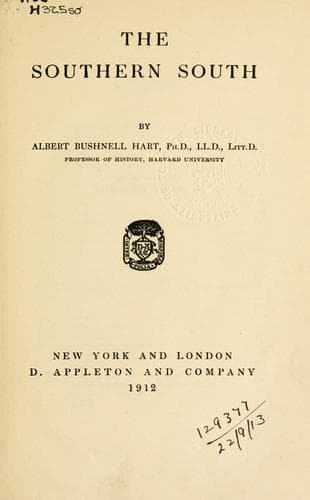
Southern States -- Social conditions; United States -- Race relations
Is the North to be "licked again" indefinitely? The suffering, the
sacrifice, and the heroism of the Civil War were as great on its side of
Mason and Dixon's line as on the other side; and the historical
perspective of that period of conflict covers some incidents which the
North forgets with difficulty. For instance, the prison of Andersonville
was hateful to the whole North. After forty years it is easier than at the
time to understand the difficulties of an impoverished government guarding
thousands of prisoners with a scanty force in a region lacking in food.
Nevertheless, it is a deep conviction of the survivors among the prisoners
and in the minds of many thousand other persons that these inherent
difficulties were aggravated by the incompetency and heartlessness of
Captain Wirz, who by accepting command assumed the responsibility for the
condition of things. By the best showing of his friends he was an
incompetent man, who had the power of life and death over thousands of his
fellow-men, and let many of them die for want of humanity and common
sense. The only reason for remembering Wirz is that he was obnoxious to
the Northern soldiers in a time of great excitement. Yet the South of Lee
and Jackson and Sidney Johnston has erected a monument to that man who
performed no service to the Confederacy except to be executed, who led in
no heroic action, represents no chivalry, and who did not so much as
capture a color or an army wagon. It is an example of what in other parts
of the world is thought an emotional disinclination to look facts in the
face.
As to the period since Reconstruction--that is, the last thirty years--the
acute sensibility of the South no longer takes the form of accusing the
North of an attempt to submerge the white race, but rather is turned
toward enlarged news of Southern wealth and prestige, which will be
examined later in this book. It has been the service of Southern writers,
teachers, and public men to look facts more squarely in the face. Still,
one finds now and then an old man of the old Benton spirit. About two
years ago a Mississippi newspaper greeted a visitor who had previously
expressed some opinions on the South, as "an object of distaste to all
decent people of Mississippi.... This blue-abdomened miscreant ... would
have the world believe that the South has burnings, lynchings, and such
horrors, with special trains, and the children of the public schools to
witness. Are the people of Jackson going to hear this traducer of them;
this man who prints broadcast over the country baseless slanders against
the people who misguidedly invited him down here? Are they going to hear a
man filled with venom who will take their good name." And a high-toned
Southern gentleman, up to that time a personal friend of the Northerner,
thought it necessary to print a card in a newspaper, setting forth the
fact that he at least had no responsibility for the presence of the
Yankee.
CHAPTER VIII
NEGRO CHARACTER
Public-domain text, read in full here on John Shaqi.
Reviews
Reviews
No reviews yet
Be the first to share your thoughts on this work.
Elsewhere in the archive
Join the Discussion
Join the discussion
Sign in to leave a comment or review.
Sign InorCreate an account