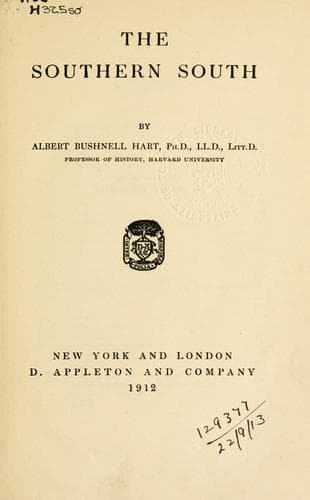
Southern States -- Social conditions; United States -- Race relations
Liberia's road, Liberia's trams,
For steady jobs want Afro-Ams.
The barber shops, like Uncle Sam's,
Give hope to myriad Afro-Ams.
There's bacon, hominy, yes, hams,
For all industrious Afro-Ams.
With faintest praise Liberia damns
The slow-arriving Afro-Ams.
Unless their woes at home are shams,
Why don't they go, the Afro-Ams?
The inquiry of the final stanza is to the point, for though the American
Colonization Society is still in existence, and within a few years has
tried to send out a shipload of Negroes, Liberia attracts almost nobody
and is a failure, either as a tropical home for the American Negro or as a
center of Christianity and civilization for Africa.
How is it with the colonies and independent states of Americanized
Africans in the West Indies, where there have been blacks for as much as
four centuries? Of these communities Cuba, Porto Rico, Jamaica, Trinidad,
the Windward and Leeward Islands were, or have been until recently,
European colonies. Cuba's population is about half Negro; and they come
nearer social and political equality with the Whites than anywhere else in
the world; but there the dominant element is the pure Spanish or Spanish
mestizo. In Jamaica since the emancipation of 1833 the races have had but
one conflict, that of 1866, which was at the time thought to be due to the
cruelty and panic of Governor Eyre. The blacks of Jamaica, to a large
extent small proprietors, support themselves in the easy fashion of the
tropics; but the 15,000 Whites who live among the 750,000 blacks seem less
able than the like class in the Southern states to organize negro labor
and make it profitable. The Negroes are taught to read and write, they
have furnished thousands of acceptable laborers for the Panama Canal, and
their death-rate is nearly down to the normal figures of the white people
for their latitude. Their illiteracy, however, is about that of their
brethren in the United States and nearly two thirds of all the children
are illegitimate. Their government is practically still, as for two
centuries and a half, out of their hands and in control of the English.
Public-domain text, read in full here on John Shaqi.
Reviews
Reviews
No reviews yet
Be the first to share your thoughts on this work.
Elsewhere in the archive
Join the Discussion
Join the discussion
Sign in to leave a comment or review.
Sign InorCreate an account