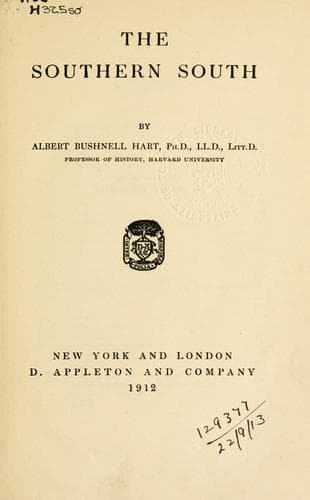
Southern States -- Social conditions; United States -- Race relations
Nobody accepts church or fraternal orders as the measure of the Negro's
place in the community, for the gospel which he hears most often is the
gospel of work; and that comes less from the preacher than from the
reformer; as DuBois says: "Plain it is to us that what the world seeks
through desert and wild we have within our threshold--a stalwart laboring
force, suited to the semi-tropics." The labor system and labor ideal of
the South are very different from those of the North. First of all, there
is the old tradition of slavery times that manual toil is ignoble; that it
is menial to handle prime materials, and to buy and sell goods across the
counter. But somebody must perform hard labor if the community is to go
on; and there is an immense field for uneducated men. Besides the
so-called "public works"--that is, turpentine, sawmills, building levees
and railroads, and clearing land--there is the pulling and hauling and
loading in the ports, the rough work of oil mills and furnaces and mines,
and above all the raising of cotton, where the demand for labor is always
greater than the supply.
Some of this labor is done by white gangs, and many of the blacks are
engaged in other and higher pursuits; but the chief function of the Negro
in the South is the rough labor which in the North was once chiefly
performed by Irishmen, later by Italians, and now in many places by
Slavs. This vast industrial system is almost wholly officered by Whites,
who are the owners, employers, and managers of nearly every piece of
property in the South on which laborers are employed. They set, so far as
they can, the terms of employment; but what they get in actual work is
settled by the Negroes, notwithstanding a condition of dependence hard to
realize in the North. It is firmly fixed in the average white employer's
mind that the Negro exists in order to work for him, and that every
attempt to raise the Negro must steer clear of any suspicion that it will
lead him to abandon work for the white man. The slow drift of Negroes to
the towns and cities cannot be prevented, nor some shifting from
plantation to plantation; but the white man's ideal is that the Negro is
to stay where he is, and hundreds of thousands of them are living within
sight of the spot where they were born.
Public-domain text, read in full here on John Shaqi.
Reviews
Reviews
No reviews yet
Be the first to share your thoughts on this work.
Elsewhere in the archive
Join the Discussion
Join the discussion
Sign in to leave a comment or review.
Sign InorCreate an account