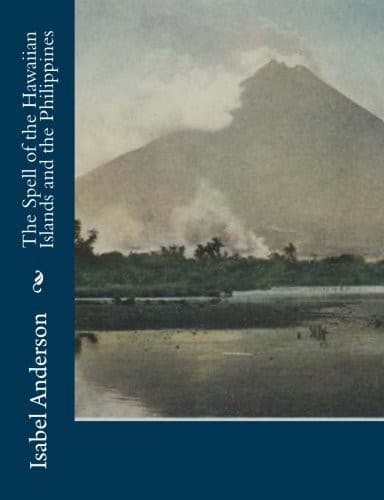
The Spell of the Hawaiian Islands and the PhilippinesAnderson, Isabel
History
The Spell of the Hawaiian Islands and the Philippines
Anderson, Isabel
Hawaii; Philippines
Although these islands are bounded on the north by the Balintan Channel,
through which some of the shipping passes from America to the southern
part of China, they are seldom visited. This is because, as I have said
before, there are no ports, not even good anchorages. During the typhoon
season they are exposed to the full force of these great hurricanes,
while the waters are infested with hidden rocks and coral ledges. The
U. S. cruiser _Charleston_ ran aground on a coral reef east of the
island of Camaguin in 1900 and sank immediately. During the
Russo-Japanese war the fleet of the Russian Admiral Rojesvenski passed
on either side of Batan Island. The Japanese had observers on the summit
of Mt. Iraya on this island, who are supposed to have signaled by
heliograph to Mt. Morrison in Formosa of the coming of the fleet. The
great armada could be seen from this mountain for more than one hundred
miles.
CHAPTER VII
AMONG THE HEAD-HUNTERS
When the Americans first came to the Philippines, most of the mountain
country could be reached only on foot over dangerous trails. Very large
tracts were unexplored, and the head-hunting tribes, who are found
nowhere but in this northern part of Luzon, pillaged the neighbouring
towns. A state of order has now been established, except in parts of
Kalinga and Apayao.
The Mountain Province, the home of the head-hunters, includes the
sub-provinces of Benguet, Lepanto, Amburayan, Bontoc, Ifugao, Kalinga
and Apayao. The officers of the provinces are a governor, a
secretary-treasurer, a supervisor in charge of the road and trail work
and the construction of public buildings, and seven lieutenant
governors. All these officers are appointed by the governor general.
They live on horseback, undergo great hardships and also take great
risks.
The manners and customs of these head-hunting tribes differ somewhat.
Each one, for instance, has a different mode of treating the captured
head when it is brought in, but all celebrate a successful hunt with a
cañao, or festival. The Ifugaos place the head upon a stake and hold
weird ceremonial dances around it, followed by speech making and the
drinking of _bubud_, as they call their wine; afterward the skull of the
victim is utilized as a household ornament. Venison and chicken are
served at such feasts and the large fruit-eating bats, which are
considered delicacies. If one of the tribe has been so unfortunate as to
have his head taken, they berate the spirit at the funeral, "asking him
why he had been careless enough to get himself killed."
The most picturesque of the head-hunting tribes that my husband saw were
the Kalingas, who are different from all other natives of Luzon. It is
said that the Spaniards took fifteen hundred Moros into this part of the
country more than a hundred years ago, so they may have founded this
tribe. At all events, the Kalingas are superbly developed, tall and
slight, some of the men having handsome and almost classical features.
Public-domain text, read in full here on John Shaqi.
Reviews
Reviews
No reviews yet
Be the first to share your thoughts on this work.
Elsewhere in the archive
Join the Discussion
Join the discussion
Sign in to leave a comment or review.
Sign InorCreate an account