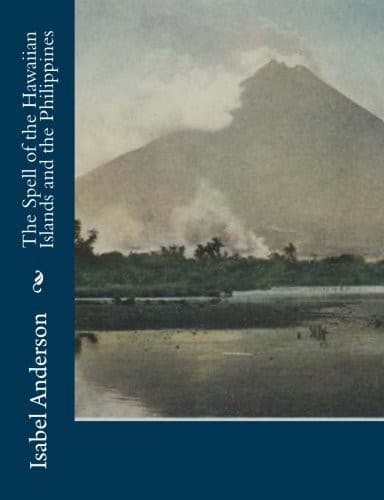
The Spell of the Hawaiian Islands and the PhilippinesAnderson, Isabel
History
The Spell of the Hawaiian Islands and the Philippines
Anderson, Isabel
Hawaii; Philippines
"You fool boy, you catchy me one bath."
Ah Sing seemed to understand. He would wag his head and answer, "You
good man, no talky all the time, makey me sick." And he would disappear.
At sight of a tall, genial man, the people in their cots would sing out,
"Doctor Heiser's a friend of mine, a friend of mine, a friend of mine,"
etc. American judges, and Filipino congressmen and generals were of the
company. Occasionally a whisper, very often a giggle, sometimes a
clinking of glasses, and good night kisses, were heard, and then the
sand man closed our eyes.
[Illustration: A MORO _DATO_ AND HIS WIFE, WITH A RETINUE OF
ATTENDANTS.]
CHAPTER IX
THE MOROS
On reaching Mindanao, the land of the Moros, we went ashore at Camp
Overton, where we were met by army officers and dougherties drawn by
teams of six mules. After a hand-shake at the commanding officer's home,
we were furnished with a big escort of cavalry and started climbing up,
up, among the hills. Soldiers were hidden in the tall grass all along
the way to make sure that nothing would happen to "the great White
Sultan with the big Red Flag," as the Moros called the Secretary. Army
men could not go out alone, even in those days, for they were attacked
by bands and killed, principally to get their weapons, which the Moros
were very keen to possess. The _datos_, the head men of the Moro tribes,
were allowed to have guns, but none of the other natives. A storm came
up, however, not long ago on Lake Lanao, at Camp Keithley, and for fear
that his boat would upset, General Wood had a great deal of ammunition
thrown overboard, which, it was discovered, was subsequently fished up
by the natives.
The Moros are Mohammedan Malays. They came in their boats from islands
further south, and in 1380 were converted to Islam by an Arab wise man,
Makadum,[26] who made his way to Sulu and Mindanao.
One hears then of Raja Baginda, who came from Sumatra in 1450; his
daughter married Abu Bahr, the law giver, who established the Mohammedan
Church and, after his father-in-law's death, became sultan and founded a
dynasty. In the old days the Moros were all pirates and slave traders.
Both Spanish and American authorities have tried to suppress slavery,
but it still exists. It is said a woman will bring about forty pesos.
A dato's slaves to-day are well treated, and form part of the family. A
slave, moreover, has a chance to rise in the social scale, for Piang,
whom we met, was once a slave, but became a powerful chief and a friend
of the Americans.
The ruler of all the Moros is the Sultan of Sulu, whom we did not see
because he was in Europe at the time we were in the Islands. It is said
that a few years ago he would sometimes appear in the market on the
back of a slave, with an umbrella held over his head. Here he would stay
while the people kissed his hands and feet. He may have changed his
customs since his trip.
Public-domain text, read in full here on John Shaqi.
Reviews
Reviews
No reviews yet
Be the first to share your thoughts on this work.
Elsewhere in the archive
Join the Discussion
Join the discussion
Sign in to leave a comment or review.
Sign InorCreate an account