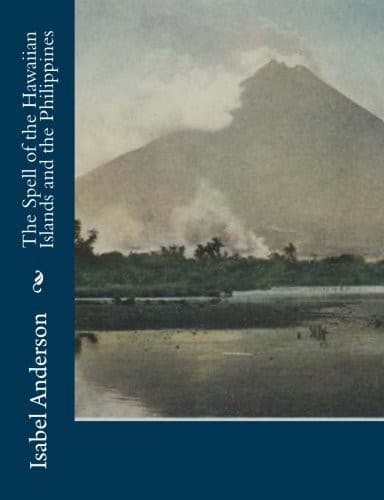
The Spell of the Hawaiian Islands and the PhilippinesAnderson, Isabel
History
The Spell of the Hawaiian Islands and the Philippines
Anderson, Isabel
Hawaii; Philippines
We were much interested in the sights in the streets. There were
numbers of _carromatos_, little covered two-wheeled carriages, drawn by
stocky Filipino ponies. The streets in this part of the town are wide,
and the houses have overhanging balconies, in Spanish style. In honour
of the Secretary, the buildings were draped with flags. Near the wharf
the land had lately been filled in, and great docks were in
construction. There was a new boulevard near the old Luneta, and an
avenue named after President Taft, besides a big hotel and a hospital
that had then just been finished. The harbour was filled with vessels,
electric cars were running, and autos were to be seen, so at first it
all looked quite up to date, until you met a carabao slowly swaying down
the street, hitched to a two-wheeled cart, with a brown boy in red
trousers, _piña_ shirt and a big straw hat sitting on his back--"carry
boy," as Secretary Dickinson named the animal. The "carry boys" do not
like white people, and sometimes charge them, stamping and goring them
with their horns, but a small Filipino boy seems to have perfect control
of them, and if they are allowed occasionally to wade in a puddle, which
cools them off, they do not "go _loco_," or crazy.
It was in the palace of Malacañan, or Government House, as it is
sometimes called, that Secretary and Mrs. Dickinson and ourselves
stayed with the Governor General. This is a large, rambling structure in
a garden by the Pasig River. Under the porte-cochère we entered a stone
hall, off which were offices, then went up a long flight of stairs to a
big hall looking into a court. This hall was hung with oil paintings of
Spanish governors, quite well done by native artists, and in the center
stood a huge one-piece table of superb _nara_ wood, covered with
gleaming head-axes and spears, _bolos_, _krisses_, _campilans_, and
_lantankas_, used by the wild tribes and Moros.
Our rooms were large and empty, as was the entire palace--indeed, so are
all the houses on account of the heat. The polished floors, too, are
made of huge planks, sometimes of such valuable tropical woods as
rosewood and mahogany, and are left bare. It took a little time to
accustom ourselves to the hard beds with rattan bottoms, covered only by
two sheets. They were carved and four-posted, and draped with mosquito
netting. Two little brown lizards squeaked at us in a friendly manner,
and crept down the walls, out of curiosity, no doubt, little ants kept
busily crawling across the room in a line, and the mosquitoes that hid
in my clothes in the rack during the daytime buzzed about at night. The
heat was great, notwithstanding the electric fan, but the sliding
screens that formed the sides of the room gave us some relief. These
shutters are like Japanese _shoji_, made of small panes of an opalescent
shell to soften the intensity of tropic sunlight, with green slit bamboo
shades pulled halfway down.
Public-domain text, read in full here on John Shaqi.
Reviews
Reviews
No reviews yet
Be the first to share your thoughts on this work.
Elsewhere in the archive
Join the Discussion
Join the discussion
Sign in to leave a comment or review.
Sign InorCreate an account