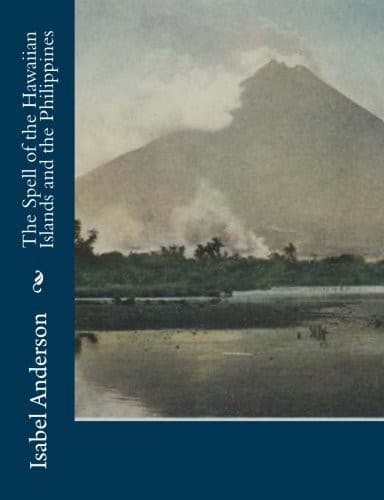
The Spell of the Hawaiian Islands and the PhilippinesAnderson, Isabel
History
The Spell of the Hawaiian Islands and the Philippines
Anderson, Isabel
Hawaii; Philippines
When I used to write or read I sat on my rattan bed under the mosquito
netting; there I could look out of the parted sides of the house to the
red hibiscus border of the garden stretching along the narrow Pasig.
Boatmen, in conical straw hats, perched at the ends of their _bancas_,
paddled the hollowed-out logs rapidly through the water, or floated idly
by, smoking their cigarettes; these boats were loaded to the gunwale
with green grasses, and had canopies of matted straw. Launches, too,
came chugging past, towing the big high poops covered with
straw-screened _cascos_. Over beyond the river was a flat all in a green
tangle, with the thatched _nipa_ houses on their stilts. For the palace
stands outside the more thickly settled parts of the city, which in turn
surround the walled town.
[Illustration: _The Pasig River_]
Manila to-day is a curious mixture of native _nipa_ shacks and old
Spanish churches and forts with the up-to-date American buildings and
improvements. There are the different quarters, as in all cities of
the Orient--Chinese, native and so on--and each has its own distinctive
sights. The street smells, which are never lacking in a city, reminded
us of India.
The walled city has picturesque gates breaking through the old gray
battlements--the massive wall was begun in 1590--and ancient sentry
houses at the corners, while behind rise the white balconies of old
convents and monasteries, and buildings now used for government
purposes, and towers of churches. The old moats have been filled up for
sanitary reasons and are being made into wide sweeps of lawn and flower
gardens, and the famous Malecon, the drive beneath the city walls, which
was once upon the sea front, has been removed too far inland by the
filling of the harbour to retain its old charm.
"Intramuros" (within the walls) more than half the land belongs to the
Church, and church buildings abound. These are really inferior, compared
with those we saw in Mexico, but some of them are very old. The
Augustinian Church, finished in 1605, has enormously thick walls and a
stone crypt of marvelous strength.
In the center of the town is Plaza McKinley, but the main business
street is the narrow Escolta, made to look still narrower by the
overhanging second stories of the buildings.
We visited the botanical gardens, a shaded park with winding paths
beneath acacias and mango trees. We drove, too, through the narrow
streets of the suburb of San Miguel, where we looked into tangled
gardens of tropical plants, behind which were houses with broad verandas
and wide-opening sides, covered by a wonderful screen of a sort of mauve
morning glory, which blooms, however, all day long.
Public-domain text, read in full here on John Shaqi.
Reviews
Reviews
No reviews yet
Be the first to share your thoughts on this work.
Elsewhere in the archive
Join the Discussion
Join the discussion
Sign in to leave a comment or review.
Sign InorCreate an account