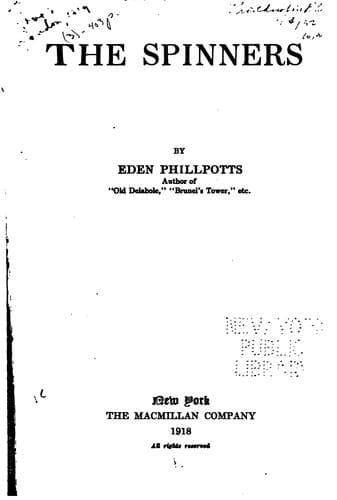
Dorset (England) -- Fiction; Illegitimate children -- Fiction; Textile industry -- Fiction
"Your fathers had a great deal more sense than you have, Baggs,"
declared Mr. Churchouse. "And if you only remember the past a little,
you wouldn't grumble quite so loudly at the present. But labour has a
short memory and no gratitude, unfortunately. You're always shouting out
what must be done for you; you never spare a thought on what has been
done. You never look back at the working-class drudgery of bygone
days--to the 'forties' of last century, when your fathers went to work
at the curfew bell and earned eighteen-pence a week as apprentices, and
two shillings a week and a penny for themselves after they had learned
their business. A good spinner in those days might earn five shillings a
week, Levi--and that out of doors in fair weather. In foul, he, or she,
wouldn't do so well. If you had told your fathers seventy years ago that
all the spinning walks would be done away with and the population
better off notwithstanding, they would never have believed it."
"That's the way to look at the subject, Levi," declared John Best.
"Think what the men of the past would have said to our luck--and our
education."
"Machinery brought the spinning indoors," continued Ernest. "I can
remember forty spinning walks in St. Michael's Lane alone. And with
small wages and long hours, remember the price of things, Levi; remember
the fearful price of bare necessities. Clothes were so dear that many a
labourer went to church in his smock frock all his life. Many never
donned broadcloth from their cradle to their grave. And tea five
shillings a pound, Levi Baggs! They used to buy it by the ounce and brew
it over and over again. Think of the little children, too, and how they
were made to work. Think of them and feel your heart ache."
"My heart aches for myself," answered the hackler, "because I very well
remember what my own childhood was. And I'm not saying the times don't
better. I'm saying we must keep at 'em, or they'll soon slip back again
into the old, bad ways. Capital's always pulling against labour and
would get back its evil mastery to-morrow if it could. So we need to
keep awake, to see we don't lose what we've won, but add to it. Now
here's a man that's a servant by instinct, and it's in his blood to
knuckle under."
He pointed to Best.
"I'm for no man more than another," answered John. "I stand not for man
or woman in particular. I'm for the Mill first and last and always. I
think of what is best for the Mill and put it above the welfare of the
individual, whatever he represents--capital or labour."
"That's where you're wrong. The people are the Mill and only the
people," declared Baggs. "The rest is iron and steel and flax and hemp
and steam--dead things all. We are the Mill, not the stuff in it, or the
man that happens to be the new master."
Public-domain text, read in full here on John Shaqi.
Reviews
Reviews
No reviews yet
Be the first to share your thoughts on this work.
Elsewhere in the archive
Join the Discussion
Join the discussion
Sign in to leave a comment or review.
Sign InorCreate an account