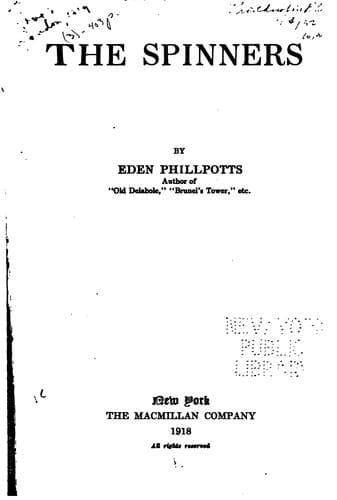
Dorset (England) -- Fiction; Illegitimate children -- Fiction; Textile industry -- Fiction
Thus the relations subsisted, while, strange to record, in practice they
had long been accepted as part of the order of things at Bridetown. They
ceased even to form matter for gossip. For Raymond Ironsyde was greater
here than the lord of the manor, or any other force. The Mill continued
to be the heart of the village. Through the Mill the lifeblood
circulated; by the Mill the prosperity of the people was regulated; and
since the master saw that on his own prosperity reposed the prosperity
of those whom he employed, there was none to decry him, or echo a
disordered past in the ear of the well-ordered present.
CHAPTER II
THE SEA GARDEN
Bride river still flowed her old way to her work and came, by goldilocks
and grasses, by reedmace and angelica, to the mill-race and water-wheel.
But now, where the old wheel thundered, there yawned a gap, for the
river's power was about to be conserved to better purpose than of old,
and as the new machines now demanded greater forces to drive them, so
human skill found a way to increase the applied strength of a streamlet.
Against the outer wall of the Mill now hung a turbine and Raymond,
Estelle and others had assembled to see it in operation for the first
time. Bride was bottled here, and instead of flashing and foaming over
the water wheel as of yore, now vanished into the turbine and presently
appeared again below it.
Raymond explained the machine with gusto, and Estelle mourned the wheel,
yet as one who knew its departure was inevitable.
It was summer time, and after John Best had displayed the significance
of the turbine and the increased powers generated thereby, Raymond
strolled down the valley beside the river at Estelle's invitation.
She had something to show him at the mouth of the stream--a sea garden,
now in all its beauty and precious to her. For though her mind had
winged far beyond the joys of childhood and was occupied with greater
matters than field botany, still she loved the wild flowers and welcomed
them again in their seasons.
Their speech drifted to the people, and he told how some welcomed the
new appliance and some doubted. Then Raymond spoke of Sabina Dinnett in
sympathetic ears.
For now Estelle understood the past; but she had never wavered in her
friendship with Sabina, any more than had diminished her sister-like
attachment to Raymond. Now, as often, he regretted the attitude his
child preserved towards him and expressed sorrow that he could not break
down Abel's distrust.
"More than distrust, in fact, for the kid dislikes me," he said. "You
know he does, Chicky. But I never can understand why, because he's
always with his mother and Uncle Ernest, and Sabina doesn't bear me any
malice now, to my knowledge. Surely the child must come round sooner or
later?"
"When he's old enough to understand, I expect he will," she said. "But
you'll have to be patient, Ray."
"Oh, yes--that's my strong suit nowadays."
Public-domain text, read in full here on John Shaqi.
Reviews
Reviews
No reviews yet
Be the first to share your thoughts on this work.
Elsewhere in the archive
Join the Discussion
Join the discussion
Sign in to leave a comment or review.
Sign InorCreate an account