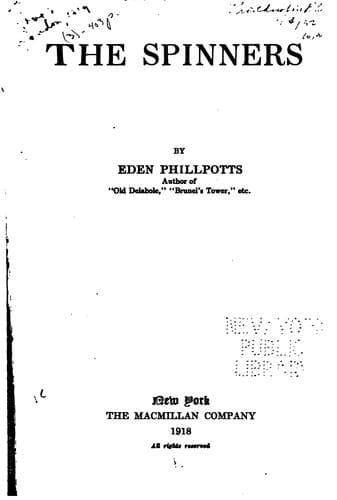
Dorset (England) -- Fiction; Illegitimate children -- Fiction; Textile industry -- Fiction
Abel talked of the Mill--self-consciously at first; yet when he found
that Estelle ignored the past, and understood spinning, he forgot
himself entirely for a time under the spell of the subject.
They compared notes, and she saw he was more familiar than she with
detail. Then, while still forgetting his listener, Abel remembered
himself and his talk of the Mill turned into a personal channel. There
is no more confidential thing, by fits and starts, than a shy child; and
just as Estelle felt the boy would never come any closer, or give her a
chance to help him, suddenly he startled her with the most unexpected
utterance.
"You mightn't know it," he said, "but by justice and right I should have
the whole works for my very own when Mister Ironsyde died. Because he's
my father, though I daresay he pretends to everybody he isn't."
"I'm very sure Mister Ironsyde doesn't feel anything but jolly kind and
friendly to you, Abel. He doesn't pretend he isn't your father. Why
should he? You know he's often offered to be friends, and he even
forgave you for trying to burn down the Mill. Surely that was a pretty
good sign he means to be friendly?"
"I don't want his friendship, because he's not good to mother. He served
her very badly. I understand things a lot better than you might think."
"Well, don't spoil your lunch," she said. "We'll talk afterwards. Are
you ready for another bottle of gingerbeer? I don't like this gingerbeer
out of glass bottles. I like it out of stone bottles."
"So do I," he answered, instantly dropping his own wrongs. "But the
glass bottles have glass marbles in them, which you can use; and so it's
better to have them, because it doesn't matter so much about the taste
after it's drunk."
She asked him concerning his work and he told her that he best liked
history. She asked why, and he gave a curious reason.
"Because it tells you the truth, and you don't find good men always
scoring and bad men always coming to grief. In history, good men come to
grief sometimes and bad men score."
"But you can't always be sure what is good and what is bad," she argued.
"The people who write the histories don't worry you about that," he
answered, "but just tell you what happened. And sometimes you are jolly
glad when a beast gets murdered, or his throne is taken away from him;
and sometimes you are sorry when a brave chap comes to grief, even
though he may be bad."
"Some historians are not fair, though," she said. "Some happen to feel
like you. They hate some people and some ideas, and always show them in
an unfriendly light. If you write history, you must be tremendously fair
and keep your own little whims out of it."
After their meal Estelle smoked a cigarette, much to Abel's interest.
"I never knew a girl could smoke," he said.
"Why not? Would you like one? I don't suppose a cigarette once in a way
can hurt you."
Public-domain text, read in full here on John Shaqi.
Reviews
Reviews
No reviews yet
Be the first to share your thoughts on this work.
Elsewhere in the archive
Join the Discussion
Join the discussion
Sign in to leave a comment or review.
Sign InorCreate an account