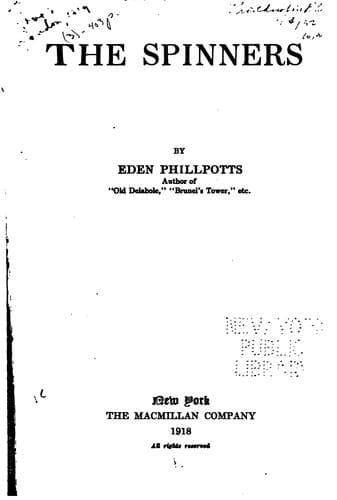
Dorset (England) -- Fiction; Illegitimate children -- Fiction; Textile industry -- Fiction
"To be simple in my life and subtle in my thought was my ambition at one
time; but I never could rise to subtlety. The native bent was against
it. The poem--I do not err in calling it a poem--is called
'Afterwards'--unless you can think of a better title. If any obvious and
glaring faults strike you, tell me. No doubt there are many."
She read the two pages written in his little, careful and almost
feminine hand.
"When I am dead, the storm and stress
Of many-coloured consciousness
Like blossom petals fall away
And drops the calyx back to clay;
A man, not woman, makes the bed
When our night comes and we are dead.
"When I am dead, the ebb and flow
Of folk where I was wont to go,
Will never stay a moment's pace,
Or miss along the street my face.
Yet thoughts may wake and things be said
By one or two when I am dead.
"When I am dead, the sunset light
Will fill the gap upon the height
In summer time, but on the plain
Sink down as winter comes again
And none who sees the evening red
Will know I loved it, who am dead.
"When I am dead, upon my mound
Exotic flow'rs may first be found,
And not until they've blown away
Will other blossoms come to stay.
A daisy growing overhead
Brings gentle pleasure to the dead.
"When I am dead, I'd love to see
An amber thrush hop over me
And bend his ear, as he would know
What I am whispering down below.
May many a song-bird find his bread
Upon my grave when I am dead.
"When I am dead, and years shall pass,
The scythe will cut the darnel grass
Now and again for decency,
Where we forgotten people lie.
O'er ancient graves the living tread
With great impertinence on the dead.
"When I am dead, all I have done
Must vanish, like the evening sun.
My book about the bells may stay
Behind me for a fleeting day;
But will not very oft be read
By anybody when I'm dead."
She stopped and smiled with her eyes full of tears.
"I had meant to write another verse," he explained, "but I put it off
and it's too late now. Such as it is, it is yours. Does it seem to you
to be interesting?"
"It's very interesting indeed, and very beautiful. I shall always value
it as my greatest treasure."
"Read it to your children," he said, "and if the opportunity occurs,
take them sometimes to see my grave. The spot is long chosen. Let there
be no gardening upon it out of good heart but bad taste. I should wish
it left largely to Nature. There will be daisies for your babies to
pick. I forget the text I selected. It's in my will."
He bade her good-bye more tenderly than usual, as though he knew that he
would never see her again, and the next morning Bridetown heard that the
old man had died in his sleep. The people felt sorry, for he left no
enemies, and his many kindly thoughts and deeds were remembered for a
little while.
CHAPTER XIX
NEW WORK FOR ABEL
With a swift weaver's knot John Best mended the flying yarn. Then he
turned from a novice at the Gill Spinner and listened, not very
patiently, to one who interrupted his lesson.
Public-domain text, read in full here on John Shaqi.
Reviews
Reviews
No reviews yet
Be the first to share your thoughts on this work.
Elsewhere in the archive
Join the Discussion
Join the discussion
Sign in to leave a comment or review.
Sign InorCreate an account