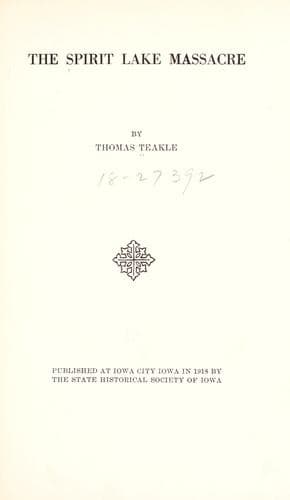
Indians of North America -- Iowa; Spirit Lake Massacre, Iowa, 1857
Laughlin and Kellogg, who had reached the timber first, had set about
the building of a fire when it was discovered that not a member of the
party had matches. Laughlin’s ingenuity, however, came to the rescue.
He had a gun and powder, and was wearing a vest with a heavy, quilted
cotton lining. Removing some of the cotton from his vest he loaded the
gun with a powder charge and rammed it down tight with cotton. He
then discharged the gun into a piece of rotten wood which, after some
attention, began blazing. Dalley soon arrived with the helpless Carse.
When the blanket wrappings were removed from Carse’s feet the skin of
the soles came with them. Dalley finally succeeded in stopping the
bleeding and in reviving him. It was only a few nights before that
Carse had befriended Dalley by taking him under his own blanket. The
boy--for such he was, being less than twenty years of age--was poorly
clad and had suffered much from the trials of the expedition. His
youthful strength and courage, however, carried him safely through to
the end. Meanwhile, Kellogg had seated himself at the base of a tree
and before anyone had observed his need for attention he too had
become unconscious from exposure. Before he could be revived it was
necessary to cut his icy clothing away from his body as the only
practicable means of removing it. When this had been done he gradually
regained consciousness and seemed but little the worse for his
experience.[271]
Laughlin and Maxwell, having attended those who were needing help and
noting that all were as comfortable as conditions would permit,
started out to cross the river with a view to locating the Irish
settlement. They found the river frozen thick enough to support them,
with the exception of a few spots over which they improvised a bridge
of poles. Making their way to the margin of the timber, they saw the
settlement in plain sight not over three miles away. Help was at once
secured which enabled them to get the disabled members of the party
across the river and to safety in the homes of the settlement. Here
they found Major Williams awaiting their coming.
Without delay Major Williams sent men down the Des Moines to look for
Johnson and his companions. They remained out during the whole of the
day; and when they returned near dark reported that they had
discovered no trace of the men, but had found a cabin in which a good
fire was burning. The Major concluded that the men had been at the
cabin and had then gone southward, following the course of the river.
Three of the five men in the party--Smith, Addington, and Murray--came
to the settlement the following morning but could give little
information concerning Johnson and Burkholder. Smith had been the last
to see them; and his story left no doubt in the minds of most of his
hearers that the two men had perished somewhere to the west of the Des
Moines River.
Public-domain text, read in full here on John Shaqi.
Reviews
Reviews
No reviews yet
Be the first to share your thoughts on this work.
Elsewhere in the archive
Join the Discussion
Join the discussion
Sign in to leave a comment or review.
Sign InorCreate an account