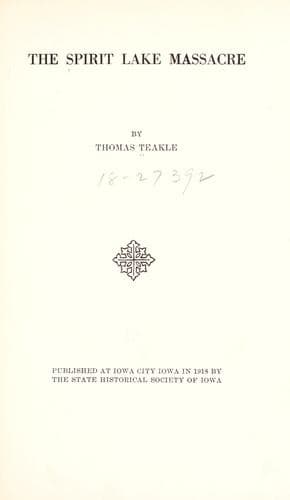
Indians of North America -- Iowa; Spirit Lake Massacre, Iowa, 1857
But Superintendent Cullen was not satisfied with what had been done
and he plainly spoke his mind. His insistence irritated not only
Little Crow, but other leaders of the Sioux at both agencies. Cullen,
however, was determined and he called a council of the Sissetons and
Wahpetons at the Upper Agency on August tenth. The Indian
representatives were sullen and Superintendent Cullen was tactless,
with the result that many sharp replies were exchanged to the
disadvantage of both parties. Wahpuja Wicasta accused the
Superintendent of being dissatisfied because they, the Indians, had
failed to bring back a piece of Inkpaduta that he, Superintendent
Cullen, might taste of it and thus pronounce upon its genuineness and
prove their good faith in the pursuit of the outlaw.[334]
Ma-za-ku-ta-ma-ni, representing the soldier lodge which had been
formed, spoke bitterly concerning the wrongs done the Indians and
accused Superintendent Cullen of breaking faith in his relations with
the soldiers and in his failure to reward the efforts which they had
honestly put forth.[335] Superintendent Cullen failed to accomplish
his purpose and in the end had to admit the need for action upon the
part of the military arm of the government. Such action he now
recommended, as well as the payment of the annuities long overdue. It
is a reflection upon the effectiveness of the military to note that no
further action was taken to punish the outlaw and his band.
For a few years Inkpaduta was lost sight of. Apparently he had ceased
his activities along the frontier. For five years he remained in
seclusion. In the summer of 1862 a portion of the band appeared at the
Yellow Medicine Agency, hoping to share in the annuities of that year.
Agent Galbraith, hearing of their presence, sent Lieutenant T. J.
Sheehan with a few soldiers to drive them away from the agency. But
their friends had warned them; and when the detail surrounded the camp
to the south of Lake Benton the Indians were gone. The trail was
followed for some distance, but it suddenly ended leaving not a trace
of its continuance.
It must not be supposed, however, that Inkpaduta contented himself
with a life of complete inactivity. He is presumed to have joined with
Little Crow in a plan for the expulsion of all whites from the Dakota
country which was to culminate in the massacres of 1862. During the
progress of this revolt his presence was several times reported, and
toward its close he is said to have gone westward and united with the
Santees of the Missouri. In a few years he succeeded in uniting this
tribe with the Yanktons and then secured the leadership.
Public-domain text, read in full here on John Shaqi.
Reviews
Reviews
No reviews yet
Be the first to share your thoughts on this work.
Elsewhere in the archive
Join the Discussion
Join the discussion
Sign in to leave a comment or review.
Sign InorCreate an account