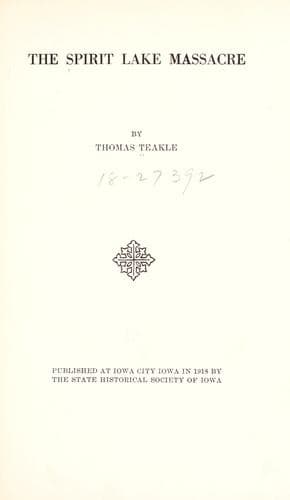
Indians of North America -- Iowa; Spirit Lake Massacre, Iowa, 1857
Upon the platform were seated ex-Governor C. C. Carpenter and Hon. R.
A. Smith, members of the relief expedition; Mrs. I. A. Thomas, Rev.
Valentine C. Thomas, and Jareb Palmer, who fortunately escaped the
massacre at Springfield; Judge Charles E. Flandrau, the Indian agent
who made possible the project to rescue Abbie Gardner, and Chetanmaza,
the Siouan Indian whose intrepidity secured her release; Mrs. Abbie
Gardner Sharp a survivor of the massacre at Okoboji; and various State
officials. The memorial was presented to the State by ex-Governor C.
C. Carpenter upon behalf of the commission under whose direction it
had been erected, and was accepted for the State by Lieutenant
Governor Warren S. Dungan and Hon. W. S. Richards.
Thus the people of Iowa, through their law-making body, paid a fitting
though somewhat tardy tribute to the memory of the pioneers who,
imbued with the true American spirit of progress, were willing to
brave the hardships of the frontier that those who came later might
share the blessings of a richer civilization. In the words of one of
the speakers of the occasion, “Let us hope that this awakening is not
ephemeral or temporary.... The story told by this memorial shaft is
but a faint expression of the toils endured, the dangers braved and
the sacrifices made by the unfortunate victims whose remains lie
buried here”.[357] The memorial “not only commemorates the great
tragedy which crimsoned the waters of these lakes, but it will keep
alive the memory of a species of American character which will soon
become extinct. As we look away to the west, we are impressed that
there is no longer an American frontier; and when the frontier shall
have faded away, the pioneer will live only in history, and in the
monuments which will preserve his memory.”[358]
XXXI
CHANGES OF SIXTY YEARS
When one looks back over the sixty years that have elapsed since
Ma-za-ku-ta-ma-ni delivered his bitter invective against white
infidelity at the Upper Agency on the Yellow Medicine, one can only
wonder at the transformation which has been wrought in what was
popularly known east of the Alleghenies as the Great American Desert.
In sixty years the frontier has moved steadily westward until to-day
it is gone not alone from the Mississippi Valley but from the American
continent. What was a vast expanse of prairie in 1857 has become a
country of prosperous homes.
Public-domain text, read in full here on John Shaqi.
Reviews
Reviews
No reviews yet
Be the first to share your thoughts on this work.
Elsewhere in the archive
Join the Discussion
Join the discussion
Sign in to leave a comment or review.
Sign InorCreate an account