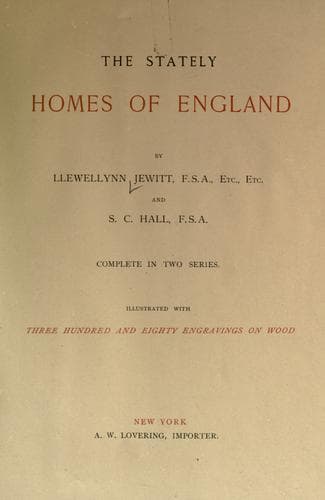
The Stately Homes of EnglandJewitt, Llewellynn Frederick William
History
The Stately Homes of England
Jewitt, Llewellynn Frederick William
Historic buildings -- England
In 1302 King Edward I. was the guest of the earl, at Arundel, and at
that time created Arundel a borough, and granted the earl certain
privileges, of taxes, &c., for the purpose of fortifying it. He was
succeeded by his son, Edmund Fitzalan, who, being taken prisoner by
Mortimer, was beheaded at Hereford. He was succeeded by his son,
Richard Fitzalan, to whom Arundel Castle, which had, on the execution
of the last earl, been giving to the Earl of Kent, was restored, as
were also the baronies of Fitzalan, Clun, and Oswestry. He led an
active and useful life, and distinguished himself at Crescy, Vannes,
Thouars, and other places, and founded a chantry of six priests at
Arundel. He was succeeded by his son, Richard, in his titles and
estates; he died on the scaffold, in Cheapside, in 1397, the king,
Richard II., being present at the execution. Ten days afterwards, “it
being bruited abroad for a miracle that his head should be grown to his
bodye againe,” the king sent, secretly, by night, “certaine nobilitye
to see his bodie taken up, that he might be certified of the truth,
which done, and perceiving that it was a fable,” he had the grave
closed up again. Through this attainder Arundel reverted to the crown,
and was given to the Duke of Exeter.
The earl was succeeded by his son, Thomas Fitzalan, who was, by Henry
IV., restored both in blood and in all his possessions and titles. He
held, among other important offices, those of Warden of the Cinque
Ports, Constable of Dover Castle, and Lord High Treasurer of England.
He married, in the presence of the king and queen, Beatrix, daughter of
John, King of Portugal, but died without issue, when the Arundel estate
passed, by entail, to his cousin, Sir John Fitzalan (or Arundel, as he
called himself), Lord Maltravers. His son, John, succeeded him as Baron
Maltravers and Earl of Arundel, and was created Duke of Touraine, but
being wounded before Beavois, was carried prisoner to that place, where
he died, and was succeeded by his son, Humphrey, who died a minor. The
title and estates then passed to the brother of Earl John, William
Fitzalan, who, in his turn, was succeeded by his son, Thomas, who again
was succeeded by his son, William, who died in 1543. This nobleman was
succeeded in his titles and estates by his son, Henry Fitzalan, who in
the four reigns of Henry VIII., Edward VI., Mary, and Elizabeth, led
a most eventful life, holding many important offices, and acquitted
himself nobly in all. He left issue, two daughters (his only son having
died a minor in his father’s lifetime), Joan, married to Lord Lumley,
and Mary, married to Thomas Howard, Duke of Norfolk. But the latter
lady having died after giving birth to a son, Philip Howard, and the
other, Lady Lumley, having been married twenty years without issue,
the earl entailed the estates, &c., on Lord and Lady Lumley for their
lives, and then to Philip Howard, the son of his sister Mary. Thus
Public-domain text, read in full here on John Shaqi.
Reviews
Reviews
No reviews yet
Be the first to share your thoughts on this work.
Elsewhere in the archive
Join the Discussion
Join the discussion
Sign in to leave a comment or review.
Sign InorCreate an account