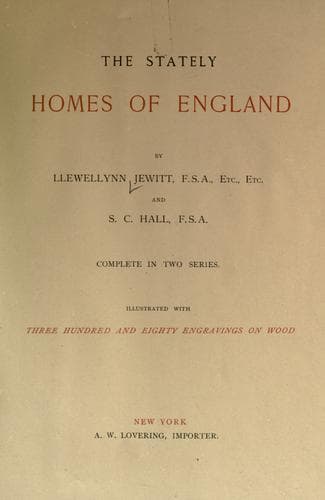
The Stately Homes of EnglandJewitt, Llewellynn Frederick William
History
The Stately Homes of England
Jewitt, Llewellynn Frederick William
Historic buildings -- England
That brilliant nobleman—whose principal crimes were his wealth,
his open, manly, and generous nature, and his wise criticisms of
the ruinous expenditure on the “field of the cloth of gold”—was
treacherously invited to court by the king, and, suspecting no
mischief, he obeyed the summons, and set out on his journey from
Thornbury, not observing for some time that he was closely followed
by three knights of the king’s body-guard, “and a secret power of
servants-at-arms.” His suspicions were first awakened at Windsor, where
he lodged for the night, “the same three knights lying close by,” and
where he was treated with marked disrespect by the king’s gentleman
harbinger. From Windsor, Buckingham rode on to Westminster, and then
took his barge to row down to Greenwich, where the court then was,
calling, however, on his way, at York House, to see Cardinal Wolsey,
who was denied to him. “Well, yet will I drink of my lord cardinal’s
wine as I pass,” said the duke: “and then a gentleman of my lord
cardinal’s brought the duke with much reverence into the cellar, where
the duke drank; but when he saw and perceived no cheer to him was made,
he changed colour, and departed.” Passing forward down the Thames,
as he neared the City, his barge was hailed and boarded by Sir Henry
Marney, captain of the body-guard, who, in the king’s name, attached
him as a traitor. He was at once carried on shore and taken through
Thames Street to the Tower, “to the great astonishment and regret of
the people, to whom he was justly endeared.” This was on the 16th of
April, 1521. On the 13th of May he was put on his mock trial and was
condemned. “I shall never sue the king for life,” said he; and he kept
his word. On the 17th he was executed, without having once supplicated
his brutal king to spare the life he was unjustly taking away. “He
was as undaunted in sight of the block as he had been before his
judges; and he died as brave men die—firmly and meekly, and without
bravado.” His death was the grief of the people. “God have mercy on his
soul, for he was a most wise and noble prince, and the mirrour of all
courtesie”—that was written of him at the time.
By this detestable piece of royal treachery Henry became possessed
of the estates of the duke, and held them in his own hands for
several years, enlarging Penshurst Park, and reaping benefit from
his unhallowed acquisitions. By Edward VI., Penshurst, with its
appurtenances, was “granted to Sir Ralph Fane, who, within two years,
was executed as an accomplice of the Protector Somerset.”
Soon after this, the young monarch gave Penshurst, with other adjoining
estates, to Sir William Sidney, one of the heroes of Flodden Field,
“who had been his tutor, chamberlain, and steward of his household from
his birth to his coronation.” Thus Penshurst came into the family of
the Sidneys, concerning whom we will proceed to give some particulars.
Public-domain text, read in full here on John Shaqi.
Reviews
Reviews
No reviews yet
Be the first to share your thoughts on this work.
Elsewhere in the archive
Join the Discussion
Join the discussion
Sign in to leave a comment or review.
Sign InorCreate an account