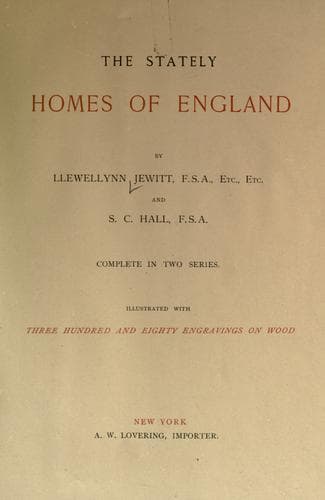
The Stately Homes of EnglandJewitt, Llewellynn Frederick William
History
The Stately Homes of England
Jewitt, Llewellynn Frederick William
Historic buildings -- England
PENSHURST, or, as it is called, Penshurst House, or Castle, or Place,
“the seat of the Sidneys,” adjoins the village to which it gives a
name. It is situated in the weald of Kent, nearly six miles south-west
of Tunbridge, and about thirty miles from London. The neighbourhood
is remarkably primitive. As an example of the prevailing character
of the houses, we have copied a group that stands at the entrance of
the churchyard—a small cluster of quiet cottages (recently, however,
rebuilt upon the old model), behind which repose the rude forefathers
of the hamlet, with brave knights of imperishable renown, and near
which is an elm of prodigious size and age, that has seen generations
after generations flourish and decay. The sluggish Medway creeps lazily
round the park, which consists of about 400 acres, finely wooded, and
happily diversified with hill and dale. A double row of beech-trees of
some extent preserves the name of “Sacharissa’s Walk,” and a venerable
oak, called “Sidney’s Oak,” the trunk of which is hollowed by time, is
pointed out as the veritable tree that was planted on the day of Sir
Philip’s birth; of which Rare Ben Jonson thus writes:—
“That taller tree of which a nut we set
At his great birth when all the muses met;”—
to which Waller makes reference as “the sacred mark of noble Sidney’s
birth;” concerning which Southey also has some lines; and from which a
host of lesser poets have drawn inspiration.
[Illustration: _The Record Tower and the Church, from the Garden._]
Until within the last thirty or forty years Penshurst House was in a
sadly dilapidated state. Its utter ruin, indeed, appeared a settled
thing, until Lord de L’Isle set himself to the task of its restoration,
and under his admirable direction it rapidly assumed its ancient
character—a combination of several styles of architecture, in which
the Tudor predominated. One of our views is of the mansion, from the
principal approach through the park. In another view the west front
is shown, the north front being seen in short perspective; on the
left is “Sir Henry’s Tower,” containing his arms, and an inscription
stating that he was “Lord Deputie General of the Realm of Ireland in
1579.” This tower terminates the north wing, in which is the principal
entrance, by an ancient gateway, leading through one of the smaller
courts to the great hall. Over this gateway is an antique slab, setting
forth that “The most religious and renowned Prince, Edward the Sixt,
Kinge of England, France, and Ireland, gave this house of Pencestre
with the manors, landes and appurtenaynces thereunto belonginge to,
unto his trustye and well-beloved servant, Syr William Sidney, Knight
Banneret.”
Public-domain text, read in full here on John Shaqi.
Reviews
Reviews
No reviews yet
Be the first to share your thoughts on this work.
Elsewhere in the archive
Join the Discussion
Join the discussion
Sign in to leave a comment or review.
Sign InorCreate an account