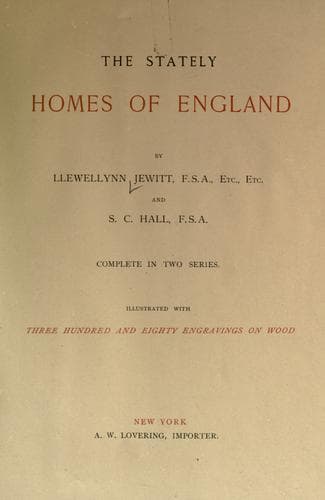
The Stately Homes of EnglandJewitt, Llewellynn Frederick William
History
The Stately Homes of England
Jewitt, Llewellynn Frederick William
Historic buildings -- England
The windows were filled with stained glass, for which the contract with
John Prudde of Westminster is preserved; but it has undergone much
change and mutilation: it still, however, especially that of the east
window, is of great beauty.[35] Adjoining the chapel is an exquisite
little oratory, with a confessional near; of these we give engravings.
[Illustration: _The Confessional._]
The Church of St. Mary is of considerable antiquity, and is mentioned
in Domesday Book. The Norman Earl, Henry de Newburgh, formed the
intention of uniting the endowments of St. Nicholas within the Castle
with St. Mary’s, which was carried out by his son, whose grant of
incorporation was executed in 1123. Probably the church was built about
that time, as the crypt is of Norman character. In the reign of Edward
III., Thomas Beauchamp ordained by his will in 1369, that a choir
should be erected; and many alterations have at one time or other been
made. A great part of the church was burnt down in 1694, and rebuilt at
a cost of £5,000, to which Queen Anne contributed £1,000. In the crypt
is preserved the ducking stool.
[Illustration: _The Oratory._]
It is desirable to add a word or two concerning “Guy’s Cave” and the
“Statue of Guy” at Guy’s Cliff, to which the visitor ought by all
means to “wend his way.” Indeed, the town of Warwick, and the whole of
the neighbourhood by which it is surrounded, is one grand assemblage
of interesting objects, of which the mind cannot tire or become
satiated. To all we have described—the towers, the lodges, the several
apartments of the castle, and to the gardens and grounds—the publicly
is freely, graciously, and generously admitted: a boon for which we are
sure every visitor will be grateful.
One of the few remaining “antiques” that yet endure to the town we
have selected for engraving—the EAST GATE; but, as will be seen, the
base only can be considered ancient; it has been “transmogrified,” yet
is still striking and interesting. The Earl of Leicester’s Hospital,
founded by Robert Dudley in 1586, is a singularly beautiful and perfect
specimen of the half-timber houses; it escaped the great fire that
nearly destroyed the town in 1694. There are not many other ancient
edifices in the venerable town.
[Illustration: _Warwick: the East Gate._]
Public-domain text, read in full here on John Shaqi.
Reviews
Reviews
No reviews yet
Be the first to share your thoughts on this work.
Elsewhere in the archive
Join the Discussion
Join the discussion
Sign in to leave a comment or review.
Sign InorCreate an account