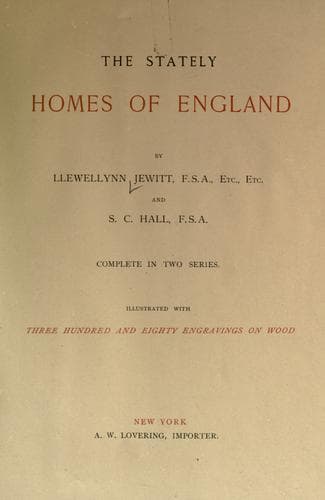
The Stately Homes of EnglandJewitt, Llewellynn Frederick William
History
The Stately Homes of England
Jewitt, Llewellynn Frederick William
Historic buildings -- England
Unequivocal evidence exists that the Romans knew the curative
properties of the Baths at Buxton; and it is almost certain, from the
many Celtic barrows and stone circles found in the neighbourhood, that
a still earlier race was acquainted with them. Probably, therefore,
for more than a thousand years Buxton has been one of the principal
“health-resorts” of this island. Yet few remains of antiquity exist
in the town. The dwelling—in which was lodged Mary, Queen of Scots,
on her several visits, while in custody of the Earl of Shrewsbury,
and to which “good Queen Bess,” while sojourning at Kenilworth, sent
the Earl of Leicester, that he might drink of the healing waters,
“twenty days together”—was removed just a century ago: a handsome and
very commodious hotel occupies the site: it is still called the “Old
Hall;” and immediately behind it are the two springs—the Saline and
the Iron—the Chalybeate and the Tonic. On a window-pane of one of the
rooms in this Old Hall, Mary, Queen of Scots, is said to have scratched
the following touching and kindly farewell—the pane of glass having
been preserved until recent years:—
“Buxtona, quæ calidæ celebrare nomine lymphæ,
Forte mihi posthac non adeunda vale!”
Cheerfulness is the handmaid of health: and, although there are many
patients in and about Buxton, they do not seem to suffer much: there
are more smiles than moans in the pump-room; and rheumatism is not a
disease that makes much outer show of anguish.
It would be difficult to find in any part of the British dominions a
drive so grandly beautiful as that between Buxton and Haddon. Within
half a mile of its centre is “the Duke’s Drive” (formed in 1795 by the
then Duke of Devonshire): it runs through Ashwood Dale, Miller’s Dale,
and Monsal Dale, passing “the Lover’s Leap” and “Chee Tor”—stupendous
crags, from the crevices of which grow small trees, partially crowned
and covered with ivy, ferns, and lichens, groups of varied foliage
intervening; with here and there umbrageous woods; and the river
Wye—not the “sylvan Wye, thou wanderer through the woods,” of
Wordsworth, but its namesake of lesser fame, that has its source a mile
or two north of Buxton—journeying all the way, until at Rowsley it
joins the Derwent (not the Derwent of the English lakes), from whence
the blended waters, running by Matlock, Belper, and Derby, flow into
the Trent, and so make their way to the sea.
[Illustration: _Haddon, from the Meadows on the Bakewell Road._]
Public-domain text, read in full here on John Shaqi.
Reviews
Reviews
No reviews yet
Be the first to share your thoughts on this work.
Elsewhere in the archive
Join the Discussion
Join the discussion
Sign in to leave a comment or review.
Sign InorCreate an account