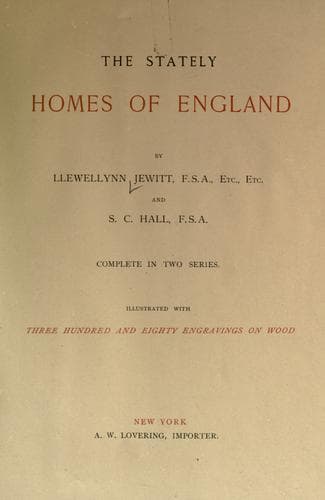
The Stately Homes of EnglandJewitt, Llewellynn Frederick William
History
The Stately Homes of England
Jewitt, Llewellynn Frederick William
Historic buildings -- England
The House of Vernon is of very considerable antiquity, and derives its
name, as do many others in the Baronage of England, from its primitive
domicile in Normandy—the _Châtellenie_ of Vernon, forming one of
the territorial subdivisions of that country: the castle, with its
hereditary lords, is recorded in the Anglo-Norman chronicles. According
to the present territorial division of France, Vernon is a commune in
the _Département de l’Eure_ and _Arrondissement d’Evreux_; and as being
the _chef-lieu_, gives name to the canton in which it is situate. From
this locality, one of the most picturesque and luxuriant of the vine
districts, the family of Vernon takes its origin; and also the ancient
family of De Redvers—the two families, indeed, being originally
identical, the name of De Redvers having been assumed by a Vernon in
the eleventh century, from the place of his residence, Révière, in
Normandy: his family were “Comtes de Révières and Vernon, and Barons
de Néhou;” both families tracing from the d’Ivry stock. Mauriscus
d’Ivry (father of Robert d’Ivry), who was father of Alselin Goël—the
names of whose sons, Roger Pincerna, surnamed “the stammerer,” Lord of
the Castle of Grossœuvre; William Lupellus (Lovel), who acquired the
castle of Ivry on the death of his elder brother; and Robert Goël—are
well known in history; the one as holding the Honour of Ivry in right
of his descent from Count Ralph, uterine-brother of Richard I., Duke
of Normandy; another as the founder of the family of Lovel; and the
third as having held his castle of Grossœuvre against King Stephen;
he had a son, Baldwin, who took the surname of De Revers from the
place of his residence: and two generations later, William, the son
of Richard, assumed the name of Vernon, from the _Châtellenie_ of
that name which he held. His son, Hugh de Revers, or Vernon, usually
called Hugh de Monachus, had a son, William de Vernon, Lord of Vernon,
who founded the Abbey of Montebourg. By his wife Emma he had issue
two sons, Walter and Richard: the latter of whom, Richard de Redvers
(as the name became afterwards spelled), or Vernon, came over at the
Conquest, and was created Baron of Shipbroke in Cheshire. He married
Adeliza, daughter of William Peverel of Nottingham, and received with
her in frank-marriage—that is, a free gift of an estate given with a
wife on her marriage, and descendable to their joint heirs—the manor
of Wolleigh, Buckinghamshire. One of these sons, Baldwin de Redvers,
was created Earl of Devon, and from him descended the line of earls of
that name; while William de Redvers, who inherited the Norman baronies
of Vernon, Révières, and Néhou, re-assumed the surname of Vernon from
those possessions. He had an only son and heir, Hugh de Vernon, Baron
of Shipbroke, who married a daughter of Raynold Badgioll, Lord of
Erdiswicke and Holgrave. By this lady he had a numerous issue: the
eldest, Warin, continuing the barony of Shipbroke; Matthew, inheriting
Public-domain text, read in full here on John Shaqi.
Reviews
Reviews
No reviews yet
Be the first to share your thoughts on this work.
Elsewhere in the archive
Join the Discussion
Join the discussion
Sign in to leave a comment or review.
Sign InorCreate an account