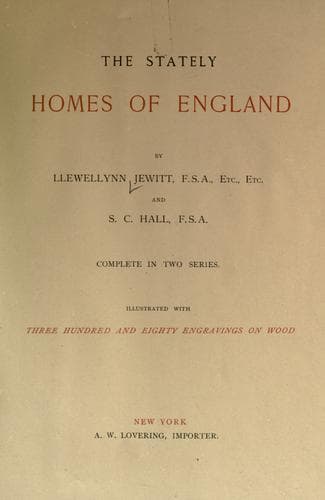
The Stately Homes of EnglandJewitt, Llewellynn Frederick William
History
The Stately Homes of England
Jewitt, Llewellynn Frederick William
Historic buildings -- England
Having now shown the descent of the Lords Vernon from the old lords of
Haddon, we return to the “King of the Peak”—Sir George Vernon—and
his heiresses. He, as has been stated, succeeded to the estates in
1515, and at the time of his death, in 1567, was possessed of no fewer
than thirty manors in Derbyshire alone. He was married twice: first,
to Margaret, daughter of Sir Gilbert Taylebois, Knt.; and, secondly,
to Maude, daughter of Sir Ralph Langford. He had issue, two daughters,
his co-heiresses, Margaret and Dorothy, whose husbands inherited his
immense possessions. Margaret Vernon married Sir Thomas Stanley, Knt.,
of Winwick, in Lancashire, second son of Edward Stanley, third Earl of
Derby; and Dorothy Vernon, whose name has become “a household word” in
this locality, married Sir John Manners, Knt., second son of Thomas
Manners, first Earl of Rutland, and direct ancestor of the present Duke
of Rutland. To this branch we shall presently have to refer at greater
length.
Sir George Vernon lived at Haddon in such a style of princely
magnificence and hospitality as to earn for himself the title of “King
of the Peak.” It is said that he was generous and hospitable, as well
one of as just and strict, of men, although given perhaps to undue
severity and to an indulgence in “Lynch law;” and that he lived and
died in the “good esteem” of all men.
One tradition, briefly told, will sufficiently illustrate the firmness
and decision of his character, and the power he held over the actions
and even the lives of the people around him. It is related that a
pedlar who had been hawking his wares in the neighbourhood was found
murdered in a lonely spot. He had been seen the evening before to enter
a cottage, and never afterwards seen alive. As soon as Sir George
became aware of the fact of the crime having been committed, he had the
body of the pedlar removed to Haddon, laid in the hall, and covered
with a sheet. He then sent for the cottager to come immediately, and,
on his arrival, at once questioned him as to where the pedlar was who
was seen to enter his house the night before. The man denied having
seen him or knowing anything about him; when Sir George uncovered the
body before him, ordering that all persons present should touch the
body in succession, at the same time declaring their innocence of the
murder. The suspected man, when his turn came, declined to touch the
body, and instantly rushed out of the Hall, and made his way, “as fast
as his legs could carry him,” through Bakewell and towards Ashford.
Sir George instantly ordered his men to mount and follow him, and to
hang him wherever they caught him. The murderer was caught in a field
opposite the present toll-bar at Ashford, and at once hanged, and the
field still bears the name of the “Gallows Acre,” or “Galley Acre.”
Sir George is said to have been cited to London for this extraordinary
piece of Lynch law, and when he appeared in court he was summoned twice
Public-domain text, read in full here on John Shaqi.
Reviews
Reviews
No reviews yet
Be the first to share your thoughts on this work.
Elsewhere in the archive
Join the Discussion
Join the discussion
Sign in to leave a comment or review.
Sign InorCreate an account