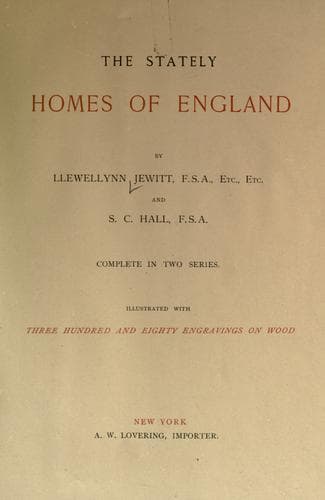
The Stately Homes of EnglandJewitt, Llewellynn Frederick William
History
The Stately Homes of England
Jewitt, Llewellynn Frederick William
Historic buildings -- England
The east window has five lights. Much of the glass has been destroyed;
what remains was re-leaded in 1858, and arranged according to the
original design. No new coloured glass was introduced, but some old
quarries were collected from other windows of the chapel, and placed
in the east window to complete the groundwork. In the centre light
the figure of our Saviour on the cross is nearly perfect. In the next
light, on either side, is a figure more or less mutilated, and each has
lost the head. One of them represents the Virgin; the other appears to
be St. John, though, apparently through some mistake of the artist, he
has the emblems of St. John the Baptist. The figures of the two outer
lights are entirely gone. The emblems of two of the evangelists remain.
In the lights of the head are figures of saints, generally well drawn.
Below the principal figures of this window are three shields of arms,
supported by angels, gracefully drawn. These arms are, _argent_, a lion
rampant _gules_, ducally crowned, _or_; _argent_, fretty, _sable_, a
canton of the first; and another shield, the bearing on which has been
lost. At the bottom of the window are the remains of an inscription to
Sir Richard Vernon and Benedict Ludlow his wife, as follows:—_Orate
pro āiābus Ricardi Vernon et Benedicite uxoris eius qui fecerunt anō
d̄ni milesimo_ CCCCXXVII. This Sir Richard Vernon, who was born in
1391, and succeeded his father in 1401, married Benedict, daughter
of Sir John Ludlow of Hodnet, and died in 1451. He was “Treasurer of
Calais, Captain of Rouen, and Speaker of the Parliament of Leicester,
in the fourth year of Henry VI. in 1426.” Above the crucifix are the
royal arms, quarterly, first and fourth France, second and third
England. In the outer lights are a knight kneeling at a table, and
fragments of an ecclesiastic.
The flat-headed windows on each side of the altar, in the north and
south sides of the chancel, have each three principal lights, and
six lights in the heads, each containing the figure of an apostle,
effectively drawn.
The centre light of the north window has a figure of the Virgin being
taught to read by St. Anne. To the right of this, as we face the
window, is the figure of St. George slaying the dragon, and in the
other light is the figure of St. Michael trampling on a six-headed
dragon. Beneath, there are three mutilated shields of arms of Vernon,
&c., and in the bottom of the window are the remains of a candlestick
or hour-glass stand. In the south window are the arms of Pype, _azure_,
crucilly of cross-crosslets and two pipes in pale, _or_; and those of
Vernon, _argent_, fretty, _sable_, on the dexter side of an impaled
shield, the impalement on which is lost. Over the arms of Pype is the
fragment of the original inscription, reading “Margareta Pype, vxo.”
Public-domain text, read in full here on John Shaqi.
Reviews
Reviews
No reviews yet
Be the first to share your thoughts on this work.
Elsewhere in the archive
Join the Discussion
Join the discussion
Sign in to leave a comment or review.
Sign InorCreate an account