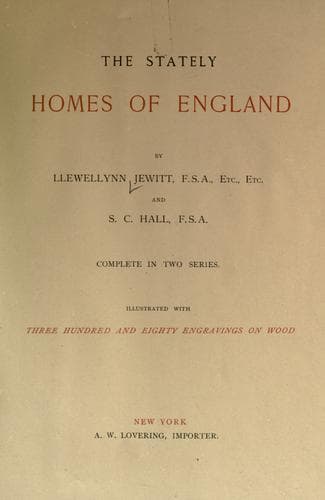
The Stately Homes of EnglandJewitt, Llewellynn Frederick William
History
The Stately Homes of England
Jewitt, Llewellynn Frederick William
Historic buildings -- England
This Sir Robert was returned in the seventeenth year of Edward III.,
as one of the principal persons in the county of Northumberland, and
was entitled to bear arms by descent. In the first year of Edward’s
reign, being governor of Norham Castle, he distinguished himself by
his successful defence of that stronghold against the Scots, who
“despising King Edward’s youth, on the very night of that day on
which King Edward was crowned, intended to take Norham Castle by
surprise; and so well managed their design, that about sixteen of them
had already mounted the walls. But the captain, Sir Robert Manners,
being warned of the matter beforehand, by one of his garrison, who
was a Scotsman, had so well prepared to receive them, that of those
who had mounted he took five or six, and put the rest to the sword,
their companions below, upon this disappointment, retiring.” In the
next year he was constituted one of the “conservators of the truce
made with the Scots for all hostilities to cease.” Soon afterwards he
was made Sheriff of the county of Selkirk, and appointed to keep and
defend the forts of Selkirk, and Ettrick, &c. In the fourteenth of
the same reign he represented Northumberland in Parliament, and again
subdued Scotch incursions. Soon afterwards he obtained a licence from
the king “to strengthen and embattle his dwelling-house at Ethale,
in Northumberland, with a wall made of stone and lime, and to hold
the same to himself and his heirs for ever.” The next year he was
constituted one of the Commissioners to treat with David Bruce and his
adherents for a peace, and subsequently was made Lord of the Marches.
At the battle of Neville’s Cross, in 1346, under Queen Philippa, in
which the Scottish king was taken prisoner, Sir Robert displayed
great valour, and was entrusted to keep charge of the prisoners, and
deliver them to the Constable at the Tower of London. He died in 1355,
leaving his son and heir, John de Manners (by his wife Aliva, or Alice,
daughter of Henry Strather), only one year and three weeks old.
Public-domain text, read in full here on John Shaqi.
Reviews
Reviews
No reviews yet
Be the first to share your thoughts on this work.
Elsewhere in the archive
Join the Discussion
Join the discussion
Sign in to leave a comment or review.
Sign InorCreate an account