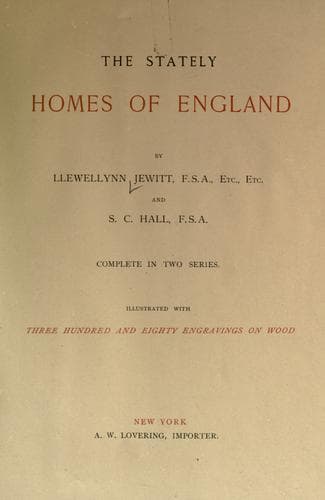
The Stately Homes of EnglandJewitt, Llewellynn Frederick William
History
The Stately Homes of England
Jewitt, Llewellynn Frederick William
Historic buildings -- England
Sir John Manners, second son of the first Earl of Rutland, and who was
consequently great grandson of the sister of King Edward IV., is the
one member of this illustrious family with whom Haddon is especially
connected. This John Manners, before he was knighted, became attached
to Dorothy Vernon, the youngest daughter and co-heiress of Sir George
Vernon of Haddon Hall, known far and wide as “the King of the Peak.”
Disguised, as we have already related, as a forester or woodman, John
Manners for some time lived in the woods about Haddon, in the hope of
obtaining occasional glimpses of, and stolen interviews with, Dorothy
Vernon; and at length so wooed that he won her, and carried her off on
horseback into his own county of Leicester, and there married her. The
story of this romantic elopement is one of the pleasantest episodes
in the history of Haddon, and will have again to be alluded to later
on. By that marriage the grand old mansion of Haddon Hall, and the
Derbyshire property of the “King of the Peak,” passed into the family
of Manners, and helped to swell its already large rent-roll of estates.
This John Manners, who was knighted in 1603, had issue by his wife,
Dorothy Vernon, three sons: Sir George Manners who succeeded him; John
Manners, who died at the age of fourteen years; Sir Roger Manners, of
Whitwell; and Grace Manners, who married Sir Francis Fortescue, of
Salden. He died June 4th, 1611; his wife died in 1584.
Sir George Manners, their son, married Grace, daughter of Sir Henry
Pierrepoint, and sister to the Earl of Kingston, by whom he had issue,
with others, John Manners, his eldest son, who not only succeeded him,
but also succeeded his own cousin George, seventh Earl of Rutland,
in his title and estates, and thus became eighth Earl of Rutland. He
married Frances, daughter of Edward, Lord Montague of Boughton, by whom
he had issue four sons and seven daughters.
He was Sheriff of Derbyshire in the ninth and eleventh years of Charles
I., and also represented that county in Parliament. His lordship was
attached to the Parliamentary interest during the Civil Wars, and was
one of the twenty-two peers who remained at Westminster when the king
summoned both houses to attend him at Oxford. As a consequence, his
castle of Belvoir was seized by the Royalists, and was held by them
and Sir Gervase Lucas, and here the king frequently resided; it was
finally surrendered to the Parliamentarians in January, 1645-6. In 1649
the castle was demolished, by consent of the earl, who soon afterwards
set about rebuilding it, which he completed in 1668. During this time
the earl lived principally at Haddon Hall, where he died in 1679. Here
he lived in a style of almost princely magnificence, maintaining a
large number of servants and retainers, and dispensing, especially at
Christmas time, his hospitality with a lavish hand.
Public-domain text, read in full here on John Shaqi.
Reviews
Reviews
No reviews yet
Be the first to share your thoughts on this work.
Elsewhere in the archive
Join the Discussion
Join the discussion
Sign in to leave a comment or review.
Sign InorCreate an account