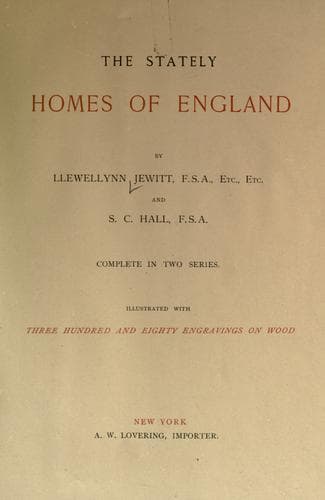
The Stately Homes of EnglandJewitt, Llewellynn Frederick William
History
The Stately Homes of England
Jewitt, Llewellynn Frederick William
Historic buildings -- England
The church was extensively repaired and restored in 1841, when numerous
very interesting remains were brought to light. These included an
extensive series of incised sepulchral slabs, of very early date,
bearing crosses of various forms, and many interesting devices; several
ancient crosses used as headstones; a considerable and extremely
beautiful assemblage of fragments of encaustic paving tiles; and
several fragments of coped tombs, and of crosses with the interlaced
ornament so characteristic of the Saxon period, as well as many
stone coffins, and sculptured fragments of mouldings, capitals, &c.,
belonging to the more ancient edifice.
Of these curious remains the greater part were preserved in the porch
of the church, and consist of considerably more than fifty incised
slabs—some of which are perfect, and others in fragments—and perhaps
a score or two of other stones. It is also stated, and is much to be
regretted, that at least four times the number of sculptured stones
preserved were rebuilt into the walls during the alterations, so that,
including a number taken away and now preserved at Lomberdale, there
must have been from three to four hundred found. In the same porch, a
selection of the ornamented paving tiles is also preserved; among the
patterns are many of extreme beauty and elegance.
The font is also deserving of especial notice. It is octagonal, each of
its sides bearing a figure beneath a crocketed canopy. A fragment of
another ancient font will be seen in the porch.
The part of Bakewell Church, however, with which we have now
particularly to do is the VERNON CHAPEL, in which, divided from the
south transept by a beautiful open oak screen, lie buried the later
Vernons and the earlier members of the Manners family connected with
Haddon. This chapel was, it appears, erected “late in the Decorated
period, about 1360, upon the walls of the former chapel. The
Early-English half-pillars at each extremity of the arches had been
retained, and were very beautiful examples, well worthy of imitation.
The hollows of the mouldings, up to a certain height, being filled
with bold roses, capitals in a different style were afterwards added
to suit the decorated arches. The central pillars, with their central
clustered shafts, are of singularly elegant design; the tracery of the
windows partakes of the flamboyant character. The upper part of the
buttresses was also altered to correspond with the new work.” It will
bear comparison with any structure of the kind in England, and has been
rebuilt in good taste.
Public-domain text, read in full here on John Shaqi.
Reviews
Reviews
No reviews yet
Be the first to share your thoughts on this work.
Elsewhere in the archive
Join the Discussion
Join the discussion
Sign in to leave a comment or review.
Sign InorCreate an account