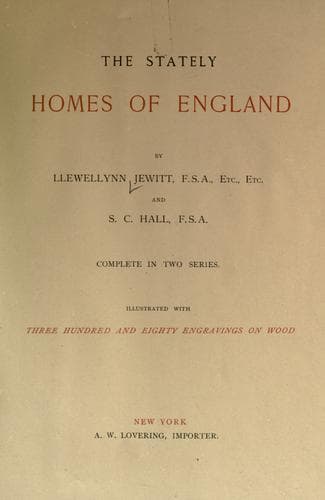
The Stately Homes of EnglandJewitt, Llewellynn Frederick William
History
The Stately Homes of England
Jewitt, Llewellynn Frederick William
Historic buildings -- England
Hatfield House lies some twenty miles from London, in the county
of Hertford, and is the seat of the most noble the Marquis of
Salisbury—the representative of the grand old line of the Cecils.
The history of the mansion is one of considerable interest, dating,
as its name _Hetfelle_ indicates, from Saxon times, and undergoing
many changes under its royal and noble and ecclesiastical owners. It
belonged to the Saxon kings until, in the reign of Edgar, it was given
by that monarch to the monastery of St. Etheldreda, at Ely, which was
founded in 673, destroyed in 870, and refounded in 970, and erected
into a bishopric in 1108, in the reign of Henry I.
[Illustration: _The Old Palace at Hatfield._]
Thus Hatfield being attached to the new bishopric, and the manor
becoming one of the many residences of the prelates, acquired, it is
said, its appellation of “Bishop’s Hatfield.” Hatfield continued to be
one of the palaces of the Bishops of Ely, and was occasionally used as
a royal residence, until the reign of Henry VIII., when it was made
over to the crown. “William de Hatfield, second son of Edward the
Third, was born at the palace,” and at various times before it finally
became vested in the crown, it was used and frequented by royalty.
During the latter part of the reign of Henry VIII. the young Prince
Edward, afterwards Edward VI., resided at this palace, and is variously
stated to have been here and at Hertford when the news of the death of
his father was conveyed to him, and when, consequently, his accession
to the crown took place. In the fourth year of his reign the youthful
monarch conveyed Hatfield to his sister, the Princess Elizabeth,
afterwards Queen Elizabeth, and here she frequently resided. Indeed,
the greater part of the troublous reign of Mary, the Princess passed at
Hatfield, “with few privations and no personal hardships to endure,”
but with much mental torture; for it must not be forgotten that she
had been removed from Ashbridge to London and imprisoned in the Tower,
for her supposed participation in Wyatt’s rebellion, and was then,
under surveillance, permitted to retire to Hatfield. It was at Hatfield
that Elizabeth, it is said, while seated under an oak, received the
welcome intelligence of the death of her sister, “the bloody Queen”
Mary, and on hearing the news she fell upon her knees, exclaiming in
Latin, _A Domino factum est istud, et est mirabile oralis nostris_ (“It
is the Lord’s doing, and it is marvellous in our eyes”), words which
she adopted as a motto for her gold coinage, while on her silver issue
she chose the somewhat similar one, _Posui Deum adjutorem meum_ (“I
have chosen God for my helper”). Thus Hatfield became identified with
the coinage of the realm as well as with many of its rulers. The day
following this event Elizabeth was waited upon at Hatfield by several
noblemen of the late queen’s Council, whom she received very kindly,
“but presently showed her decided preference for Sir William Cecil
Public-domain text, read in full here on John Shaqi.
Reviews
Reviews
No reviews yet
Be the first to share your thoughts on this work.
Elsewhere in the archive
Join the Discussion
Join the discussion
Sign in to leave a comment or review.
Sign InorCreate an account