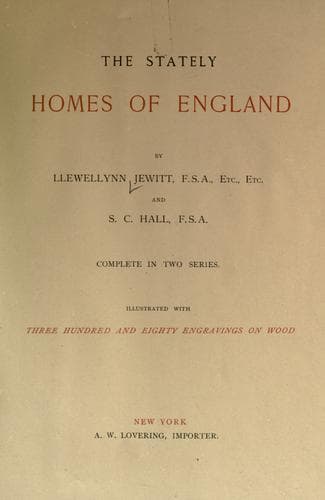
The Stately Homes of EnglandJewitt, Llewellynn Frederick William
History
The Stately Homes of England
Jewitt, Llewellynn Frederick William
Historic buildings -- England
The family of Cecil is one of considerable antiquity, and many of its
members have distinguished themselves both in statesmanship, in the
field, and in the arena of literature. The greatness of the family was
laid by Sir William Cecil, the friend and adviser of Queen Elizabeth
before she came to the throne, and her first chief Secretary of State.
“This distinguished statesman,” says Sir Robert Naunton, “was the son
of a younger brother of the Cecills of Hertfordshire, a family of my
own knowledge, though now private, yet of no mean antiquity, who, being
exposed and sent to the city, as poor gentlemen used to do their sons,
became to be a rich man on London Bridge, and purchased (estates) in
Lincolnshire where this man was born.” First he became Secretary to
the Protector Somerset, and afterwards, on the accession of Elizabeth,
he was appointed Secretary of State. In 1561 he was made President of
the Court of Wards. His great talent and assiduity won for him much
regard at court, where he was treated with great favour. In 1571 he
was created Lord Burleigh, and continued to maintain his distinguished
position in the state till his death. He resided chiefly at Theobalds,
where he often had the honour of entertaining his sovereign, who was
“sene in as great royalty, and served as bountifully and magnificently,
as at anie other tyme or place, all at his lordship’s chardge,” &c. The
events in the life of this statesman are so closely associated with the
history of England itself in the stirring times in which he lived, that
they are too well known to need more than a passing notice. After being
mixed up in every affair of state from some time before the accession
of Elizabeth, having taken part in all the proceedings connected with
the unfortunate Mary Queen of Scots, and with his own hand drawn up her
death-warrant, and after having for forty years mainly directed the
councils of the “Virgin Queen,” Sir William Cecil, now Lord Burleigh,
died on the 4th of August, 1598, in the seventh-eighth year of his age,
to the great grief of Elizabeth, who is said to have wept bitter tears
at his death.
Public-domain text, read in full here on John Shaqi.
Reviews
Reviews
No reviews yet
Be the first to share your thoughts on this work.
Elsewhere in the archive
Join the Discussion
Join the discussion
Sign in to leave a comment or review.
Sign InorCreate an account