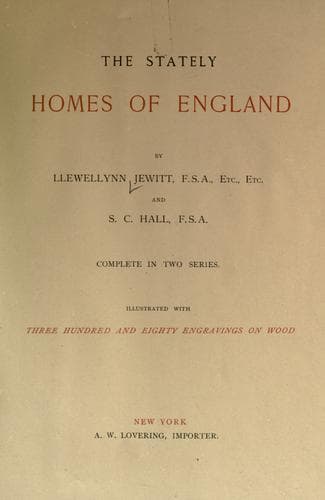
The Stately Homes of EnglandJewitt, Llewellynn Frederick William
History
The Stately Homes of England
Jewitt, Llewellynn Frederick William
Historic buildings -- England
The GRAND STAIRCASE is one of the most magnificent parts of this
palatial residence. It occupies, in plan, a space of 35 by 21 feet,
and comprises flights with five landings. “The balusters are massive,
and carved in the Italian form; above the handrail are represented
genii, armorial lions, &c., and here is a hatch-gate, probably to keep
the favourite dogs from ascending to the drawing-rooms. The upper
division of the ceiling is enriched by a very beautiful pendant in
the Florentine style,” relieved by gold and silver and colour. On the
walls are hung a series of family portraits of the Cecils by Lely,
Kneller, Vandyke, Zucchero, Reynolds, and others. At the foot of
the staircase is the DINING-ROOM, panelled throughout with oak, and
having an enriched ceiling. Over the door is a marble bust of Lord
Burleigh. Near this are the breakfast, summer, drawing, and other
rooms, all of which are fitted and furnished in a style of sumptuous
magnificence, and contain a vast number of very valuable paintings.
Among the pictures contained in this noble mansion are no fewer than
five original portraits of Queen Elizabeth, including the celebrated
large one by Zucchero; and many portraits, &c., which were the private
property of that sovereign.
[Illustration: _The Gallery._]
The GREAT HALL, or MARBLE HALL, is 50 feet by 30 feet, and is extremely
lofty. It is lit by an oriel window at the upper or daïs end, and
by three bay windows; and is panelled with oak and lined with fine
old tapestry. A carved screen, with an open gallery, decorated with
armorial bearings, badges, &c., is at the east end, and the ceiling,
which is coved and divided into compartments, is decorated with the
heads of the Cæsars. Here are deposited two banners presented to the
late marquis by the Duke of Wellington—part of the “spoil” of Paris in
1814: here are also two other banners taken in the Crimea.
[Illustration: _The Hall._]
The Staircase leads, almost direct, to KING JAMES’S ROOM, or the GREAT
CHAMBER, one of the noblest apartments of the house, the extreme
magnificence of which it is not easy to describe; in truth, it is too
rich, and the eye turns involuntarily to the grand oriel windows for
relief. The ceiling is of exquisite design, and was till recently plain
white; now it is all gold and colours. The chimney-piece is massive, of
white marble; and a central niche over the fire contains a life-size
statue of James I. in dark stone. The fire-dogs are of silver; the
furniture and the six chandeliers are gilt; the curtains are of white
satin; the chair and sofa coverings are crimson velvet; and the carpet,
“patent Axminster,” is of Elizabethan design, worked in brown, gold,
scarlet, and blue. This room, which is very large, contains some of the
most important pictures, including Reynolds’s portraits of George III.
and Queen Charlotte.
Public-domain text, read in full here on John Shaqi.
Reviews
Reviews
No reviews yet
Be the first to share your thoughts on this work.
Elsewhere in the archive
Join the Discussion
Join the discussion
Sign in to leave a comment or review.
Sign InorCreate an account