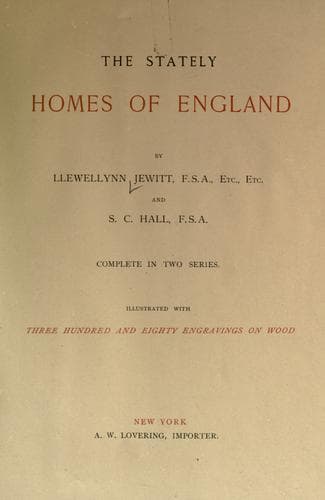
The Stately Homes of EnglandJewitt, Llewellynn Frederick William
History
The Stately Homes of England
Jewitt, Llewellynn Frederick William
Historic buildings -- England
Branching off from the cloisters is the SALOON, placed between the
dining and drawing-rooms. “Its ceiling is adorned with the painting
Evelyn mentions as belonging to the hall of the old mansion, and to
have been the work of Verrio, the subject being composed chiefly of
allegorical figures—Painting, Sculpture, Music, and War. In this
apartment are two cabinets, containing numerous miniatures painted by
the Countess of Essex,” and many family and other portraits.
In the DINING-ROOM, which is a noble apartment, with wainscoted
walls, also hang several remarkably fine family and other portraits,
by Vandyke, Hoppner, and other painters; and several fine
pictures,—notably, “The Cat’s Paw,” by Landseer, and “The Highlander’s
Home,” by Wilkie.
The GRAND DRAWING-ROOM, which is filled with all the elegancies and
luxuries of the most refined taste, and with the choicest cabinets, is
adorned with paintings by Turner, Callcott, Collins, and others. These
are of the highest order—rare and beautiful examples of the great
English masters in art. Adjoining the drawing-room is the conservatory
cloister, which is entered both from it and from the library.
The LIBRARY, which occupies four rooms,—respectively known as the
Great Library, the Inner Library, the Dramatists’ Library, and the
Small Library,—is remarkably extensive; and contains, as such a
library ought, a rare collection of valuable books in every class of
literature. In these various rooms is preserved a fine collection of
family paintings; and here, too, will be seen some of Grinling Gibbon’s
matchless carvings, which are noticed by Evelyn as being there in
his day. Among the historical relics preserved in the Library is the
handkerchief which Lord Coningsby applied to the shoulder of King
William III., when that monarch was wounded, in 1690, at the battle
of the Boyne. It is stained with the blood of the king. There is also
here a piece of the velvet pall of Charles I., taken from the tomb at
Windsor, when it was opened in 1813, with a fragment of the Garter worn
by the king at his execution.
Like these, the other apartments at Cassiobury are filled with choice
paintings and with everything that good taste and a lavish hand can
suggest. The family portraits are, as might be expected, numerous,
and of the highest order of art, several are by Vandyke, Cornelius
Jansen, Sir Peter Lely, Sir Joshua Reynolds, and other famous artists.
Throughout the rooms are scattered admirable works by Rembrandt, Cuyp,
Teniers, &c., &c.
We have made but brief reference to the gardens and grounds, and
scarcely noticed the spacious and very beautiful Park. They are charms
that neither lofty descent nor large wealth could purchase—the
bequests only of Time. Centuries have passed since some of these
magnificent trees were planted. The house is best seen from one of the
high steeps on the opposite side of the river that runs through the
demesne; lines of venerable chestnuts border a greensward that extends
miles.
Public-domain text, read in full here on John Shaqi.
Reviews
Reviews
No reviews yet
Be the first to share your thoughts on this work.
Elsewhere in the archive
Join the Discussion
Join the discussion
Sign in to leave a comment or review.
Sign InorCreate an account