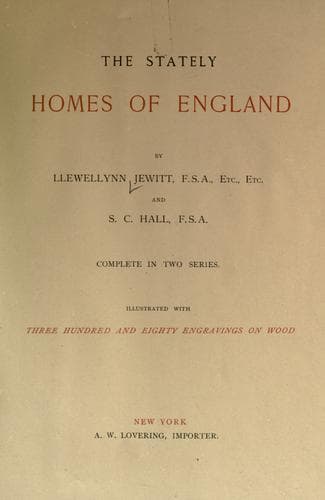
The Stately Homes of EnglandJewitt, Llewellynn Frederick William
History
The Stately Homes of England
Jewitt, Llewellynn Frederick William
Historic buildings -- England
He was succeeded by his second son by his first wife, Sir William
Cavendish, as second Earl of Devonshire. This nobleman—who had been
under the tuition of the famous philosopher, Thomas Hobbes—married
Christiana, only daughter of Edward, Lord Bruce of Kinloss, a kinswoman
of the king, “who gave her with his own hand, and made her fortune ten
thousand pounds.” By her he had issue three sons and one daughter, and
was succeeded by his eldest son, William, as third Earl of Devonshire,
who was only ten years of age at his father’s death. This nobleman
married Elizabeth Cecil, daughter of the Earl of Salisbury, by whom
he had two sons, William (who succeeded him) and Charles, and one
daughter. William, fourth Earl of Devonshire, before succeeding to
the title, was one of the train-bearers to the king on his coronation,
and sat in the Long Parliament as member for Derbyshire. His lordship
was one of the principals in bringing about “the Glorious Revolution”
of 1688, and placing William III. on the throne; the place of meeting
for plotting for the great and good change being on Whittington Moor,
not many miles from Chatsworth, at a small cottage-inn belonging to
the Duke of Devonshire, known as the “Cock and Pynot” (_pynot_ being
the provincial name of the magpie), still existing, but recently
partly rebuilt. The “plotting parlour,” as the room in this cottage is
called, in which the Earl of Devonshire met Earl Danby, John d’Arcy,
and others, to plan the revolution, is held in veneration, and the very
chair in which the earl sat during the deliberations is preserved by
his Grace at Hardwick Hall, where it has been taken, and is, indeed, a
most interesting historical relic. The earl, who, as we have already
stated, was the rebuilder of Chatsworth, married Mary, daughter of
the Duke of Ormonde, by whom he had issue three sons, William (his
successor), Henry, and James; and one daughter, Elizabeth. His lordship
was, in 1694, advanced by William III. to the dignity of Marquis of
Hartington and Duke of Devonshire. He died in 1707, and was succeeded,
as second duke and fifth earl, by his son, William Cavendish,
captain of the yeomen of the guard to the king, who succeeded to
all his father’s appointments, including being Lord Steward of the
Household, Privy Councillor, Lord Warden and Chief Justice in Eyre,
Lord Lieutenant, K.G., &c.; he was also made one of the Regents of the
kingdom. His grace married Rachel, daughter of William, Lord Russel,
and on his death was succeeded by his son William as third Duke of
Devonshire.
The third Duke, who became Lord Lieutenant of Ireland, Lord Keeper of
the Privy Seal, Lord Steward of the Household, Lord Justice for the
administration of government during the king’s absence, Lord Lieutenant
of Derbyshire, &c., married Catherine, heiress of John Hoskins, by whom
he had a numerous family. He was succeeded by his son—
Public-domain text, read in full here on John Shaqi.
Reviews
Reviews
No reviews yet
Be the first to share your thoughts on this work.
Elsewhere in the archive
Join the Discussion
Join the discussion
Sign in to leave a comment or review.
Sign InorCreate an account