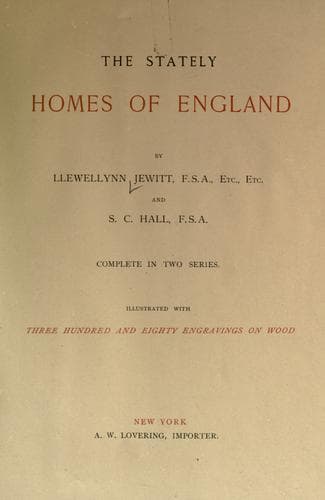
The Stately Homes of EnglandJewitt, Llewellynn Frederick William
History
The Stately Homes of England
Jewitt, Llewellynn Frederick William
Historic buildings -- England
The GREAT HALL, or GRAND HALL, is a noble room, 60 feet in length by
27 feet in width, and of the full height of the two principal stories
of the mansion. The floor is formed of polished marble, laid in a
remarkably striking geometric design, in mosaic, of black and white and
veined marbles. It was originally the work of Henry Watson, being laid
down by him in 1779; but was taken up and relaid, with considerable
alterations, by the late Duke. In the centre of the hall stands an
immense marble table, of Derbyshire marble, and the chimney-piece,
which is very massive, is also of marble. At the south end of the
hall is the grand staircase, leading to the state apartments, and at
the north end, beyond the corridor, are the north stairs. The hall is
four windows in length, and galleries of communication between the
north and south run, midway in height, along the sides. The ceiling
and walls of the upper story are painted in the most masterly manner
in historical subjects, by Laguerre and Verrio. The series of subjects
are events in the life of Julius Cæsar:—They are, his passing the
Rubicon; his passing over to his army at Brundusium; sacrificing before
going to the Senate, after the closing of the temple of Janus; and his
death in the Senate House at the foot of Pompey’s pillar; and on the
ceiling is his apotheosis or deification. Between the windows, and in
the window-cases, are also painted trophies of arms, and wreaths of
flowers, &c. In the hall are two remarkably fine bronze busts placed
upon pedestals, and other interesting objects, among which is a fine
canoe, the gift of the Sultan to the late Duke. Over the fire-place is
a marble tablet bearing the following inscription:—
“ÆDES HAS PATERNAS DILECTISSIMAS.
ANNO LIBERTATIS ANGLICÆ MDCLXXXVIII INSTITUTAS.
GUL : S : DEVONIÆ DUX, ANNO MDCCCXI HÆRES ACCEPIT,
ANNO MŒRORIS SUI MDCCCXL PERPECIT;”
which may be thus translated:—
“These well-loved ancestral halls,
Begun in the year of English Freedom, 1688,
William Spencer, Duke of Devonshire, inherited in 1811,
And completed in the year of sorrow, 1840.”
The “year of sorrow,” so touchingly alluded to, being that of the death
of the much-loved and highly-gifted Countess of Burlington, the wife of
the present noble owner of Chatsworth. On the exterior of this grand
hall, on the east side of the quadrangle, are some trophies of arms,
&c., magnificently and boldly carved in _alto-relievo_ in stone, by
Watson.
[Illustration: _The Bridge over the River Derwent, in the Park._]
Public-domain text, read in full here on John Shaqi.
Reviews
Reviews
No reviews yet
Be the first to share your thoughts on this work.
Elsewhere in the archive
Join the Discussion
Join the discussion
Sign in to leave a comment or review.
Sign InorCreate an account