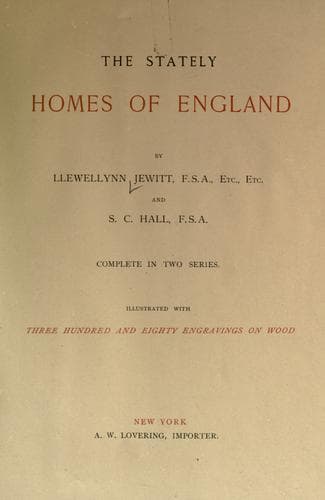
The Stately Homes of EnglandJewitt, Llewellynn Frederick William
History
The Stately Homes of England
Jewitt, Llewellynn Frederick William
Historic buildings -- England
The principal wood-carvers were Thomas Young, William Davies, Joel
Lobb, and Samuel Watson, to the latter of whom is undoubtedly due
the credit of much of the work which has of late been ascribed to
Gibbons. Those who have admired the exquisite carving of flowers, dead
game, fish, nets, festoons, &c., in the State Dining-room, to which
we have alluded, and have considered them to be by the master-hand of
Gibbons, will perhaps learn, with some little surprise, that they are
the creations of the genius of Watson (a Derbyshire worthy), and his
co-labourers, Lobb and Davies. The following is the memorandum relating
to the agreement as to this work, contained in the original book of
work done by Watson from 1690 to 1712. “Sept. 9, 1692. Joel Lobb,
William Davies, and Samuel Watson agreed with the Earl of Devonshire
to execute in lime-tree, the carving of the great chamber, to be done
equal to anything of the kind before executed, for which they were to
receive £400; this carving consists of flowers, wreaths, dead game,
cherubs,” &c. The original designs by Watson for some of the carving in
this room (as well as in others) are preserved.
Samuel Watson was born at Heanor, in Derbyshire, in 1662, and is said
to have studied under—indeed to have been an apprentice of—C. Oakley,
in London. Soon after completing his apprenticeship he commenced work
at Chatsworth, and here he continued to be employed, as the accounts
show, until 1712, only three years before his death, which took place
in 1715. He was buried at his native village, Heanor, where a tablet
remains to his memory, bearing the following verse:—
“Watson is gone, whose skilful Art display’d
To the very life whatever Nature made;
View but his wondrous works in Chatsworth hall,
Which are so gazed at and admired of all
You’ll say ‘tis pity he should hidden lie,
And nothing said to revive his memory.
My mournful friends, forbear your tears,
For I shall rise when Christ appears.
“This SAMUEL WATSON died 29th March, 1715, aged 53 years.”
There is nothing, so far as we are aware, to show by whom the carvings
in the chapel were executed, but they have been pronounced by competent
judges, and by no less an authority in late years than Mr. Rogers, to
be the work of Gibbons. The probability is they are by him, and it is
also equally probable that he was the presiding genius of the place,
supplying designs, and, besides working himself, directing the labours
of others. We regret that space will not admit of our speaking at
greater length upon this tempting and fascinating subject; but, giving
one or two engravings of portions of the carvings,[39] we must now pass
on to say a few words concerning the exquisite modern decorations of
the private library and rooms adjoining.
Public-domain text, read in full here on John Shaqi.
Reviews
Reviews
No reviews yet
Be the first to share your thoughts on this work.
Elsewhere in the archive
Join the Discussion
Join the discussion
Sign in to leave a comment or review.
Sign InorCreate an account