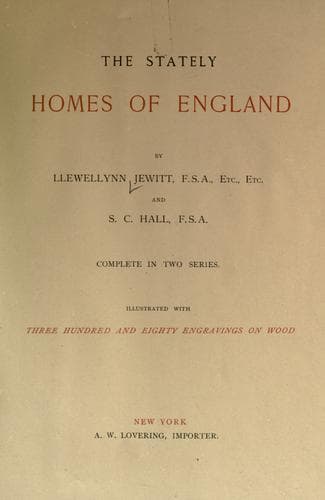
The Stately Homes of EnglandJewitt, Llewellynn Frederick William
History
The Stately Homes of England
Jewitt, Llewellynn Frederick William
Historic buildings -- England
Distant from London, north by west, 313 miles (by railway), Alnwick,
the county-town of Northumberland, is pleasantly situated on high
ground, rising about 200 feet above the sea-level, on the south bank
of the river Aln. From the name of this river, with the addition of
_wick_, a place of human habitation, ALNWICK, always pronounced by its
native inhabitants “Annick,” is evidently derived.[20]
[Illustration: _Alnwick Castle, from the River Aln._]
Still remaining but little changed from what it was in times long
passed away, while from the humblest of origins other towns have grown
up and increased until they have attained to great magnitude and
wealth and importance, Alnwick derives its interest from its early
association with our national history—an association blended with the
connection of the town with its castle, and with the great barons, the
lords of that castle. The site of the castle and town of Alnwick is of
a character which necessarily leads to the conclusion, that it must
have been occupied both by a settlement and by some stronghold from a
very remote period; and this opinion is confirmed by the presence of
numerous relics in the immediate neighbourhood, that may be assigned
without hesitation to ages anterior to the Roman settlement in Britain:
the authentic history of Alnwick, however, cannot be carried back
further than the era of the Norman Conquest, and even then for awhile
more than a little of uncertainty overshadows the earliest pages of the
chronicle. There exists no evidence to show that in the year 1066 any
castle was standing at Alnwick; nor have we any knowledge of what lords
may have held the high ground on the southern bank of the Aln during
the Anglo-Saxon rule.
On Alnwick Moor, and in many places in the neighbourhood, are some
remarkably interesting camps and other earth-works, and also some
barrows, in which various relics have been discovered. In one of these
was found a stone cist, containing a skeleton in the usual contracted
position of Celtic interments; and in another, in a similar cist,
was found a fine food-vessel, ornamented with a lozenge pattern. In
other barrows Celtic remains, including cinerary urns, drinking-cups,
food-vessels, flints, celts, and other implements of stone, bronze
daggers, &c., have been found, and prove incontestably the early
occupation of the site of Alnwick. In the neighbourhood, too, occur
many of those curious remains of antiquity, sculptured stones, bearing
circles and other rude and singular characters, which are supposed to
be inscriptions.
Public-domain text, read in full here on John Shaqi.
Reviews
Reviews
No reviews yet
Be the first to share your thoughts on this work.
Elsewhere in the archive
Join the Discussion
Join the discussion
Sign in to leave a comment or review.
Sign InorCreate an account