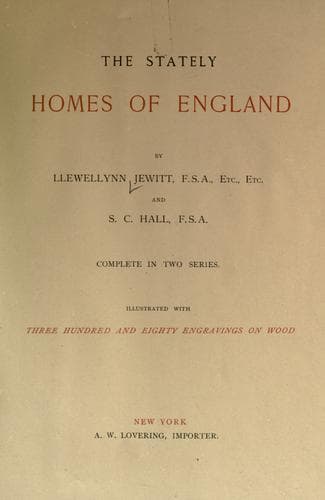
The Stately Homes of EnglandJewitt, Llewellynn Frederick William
History
The Stately Homes of England
Jewitt, Llewellynn Frederick William
Historic buildings -- England
The one circumstance connected with the career of Yvo de Vesci that
has come down to us is the fact that he began to build the earliest
parts of the existing castle of Alnwick. With the barony, the castle
of Alnwick passed to Eustace Fitz-John by his marriage with Beatrix,
the heiress of Yvo de Vesci. In the hands of this able baron, Alnwick
Castle was “most strongly fortified:” he also founded the monastery of
Alnwick, and in 1157 was succeeded by his eldest son, William, who, in
honour of his mother, assumed the name of De Vesci. In the time of this
baron, another King of Scotland found that the neighbourhood of Alnwick
Castle was no place of safety. In the year 1174 William the Lion, while
besieging the fortress of the De Vescis, was taken prisoner, and the
large army under his command was completely routed, De Vesci himself
taking an active part in the fierce struggle. His descendant, John De
Vesci, who died in 1288, leaving no issue, founded and endowed Hulne
Abbey; and he was the first baron of his house who was summoned by the
king to the parliament by writ, his predecessors having been barons by
tenure. William De Vesci III., one of the claimants of the Scottish
crown, was born in 1245, and succeeded to the barony of Alnwick on the
death of his brother. The last baron of Alnwick of his race, he died in
1297, without legitimate issue, having infeoffed the celebrated Anthony
Bec, Bishop of Durham, with all his lands and his castle of Alnwick, to
hold them in trust for an illegitimate son. But in 1309 the bishop sold
the castle and barony of Alnwick to Henry de Percy; and this conveyance
was confirmed by Edward II. in 1310.
Deriving, as it would seem, their memorable name from that district
in Normandy in which from an early period, long before the Norman
Conquest of England, their family had been established, the PERCIES
were represented in the ranks of the Conqueror at Hastings by William
de Percy, who assumed the additional name of Le Gernons, or Algernon,
as a personal epithet denoting the mass of hair which he wore about
his face. About 1166, or almost an exact century after the battle of
Hastings, the wealth, dignities, and power of the Percies centred in an
heiress who, perhaps in 1168, married Josceline de Louvain, second son
of the Duke of Brabant, and half-brother to the second queen of Henry
I. of England. A legend has been preserved, which relates that on her
marriage with Josceline, Agnes de Percy stipulated that her husband,
at his own option, should assume either the arms or the name of Percy;
and it is added that the bridegroom elected to retain his own arms, the
blue lion rampant of Brabant, while he assumed the paternal surname
of his bride. This legend, however, must be regarded as the poetic
offspring of a later age, since at the time of the marriage of Agnes de
Percy armorial insignia had neither assumed any definite character, nor
had any such insignia become hereditary.
Public-domain text, read in full here on John Shaqi.
Reviews
Reviews
No reviews yet
Be the first to share your thoughts on this work.
Elsewhere in the archive
Join the Discussion
Join the discussion
Sign in to leave a comment or review.
Sign InorCreate an account