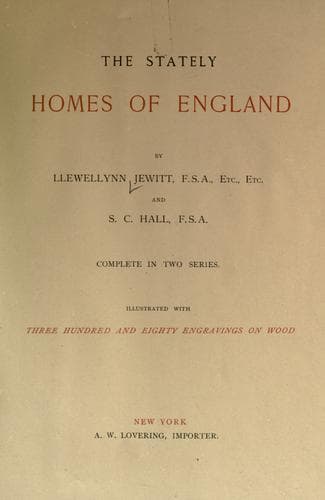
The Stately Homes of EnglandJewitt, Llewellynn Frederick William
History
The Stately Homes of England
Jewitt, Llewellynn Frederick William
Historic buildings -- England
Henry de Percy, eldest son of the first baron, succeeded his father
as second Baron Percy of Alnwick; he died in 1352, leaving, by his
wife Idonea de Clifford (whose magnificent monument, with its rich and
splendid architectural canopy, unsurpassed in England, and also without
a rival in its remarkable condition of preservation, is the pride of
Beverley Minster), four sons, of whom the eldest, Henry, succeeded as
third Baron Percy of Alnwick. This baron died in 1368; his eldest son,
by Mary of Lancaster, Henry de Percy, sixth of his name and fourth
baron, was created EARL OF NORTHUMBERLAND by Richard II., and High
Constable of England. This great noble fell a victim to the tyranny of
Henry IV., at Bramham Moor, in 1409. He was thrice married: first to
Elizabeth, heiress to the Earl of Angus, by whom he acquired the barony
of Prudhoe; secondly to Margaret de Neville; and thirdly to Maud de
Lucy, sister and heiress of Lord Lucy, widow of Gilbert de Umfraville,
and mother of her second husband’s first wife: and by these alliances
the barony of Prudhoe, with the estates of the Lucys and the castle
and honour of Cockermouth, became annexed to the Percy earldom. Sir
Henry de Percy, known by his surname of HOTSPUR as well in song as in
history,—
“Who was sweet Fortune’s minion and her pride,”
the earl’s eldest son, was killed near Shrewsbury in 1403. At Trotton,
in Sussex, a fine monumental brass commemorates Elizabeth de Mortimer,
wife of Hotspur, and afterwards of Lord Camoys.
[Illustration: _The Keep._]
After several years the fortified honours and estates of the Percies
were restored to Henry, the son of Hotspur, who thus became the second
Earl of Northumberland. This great earl was killed, fighting under
the red-rose banner, at St. Albans, in 1455; and was succeeded by his
fourth surviving son, by his marriage with Eleanor de Neville, another
Henry, who, with one of his brothers, fell at the disastrous rout of
Towton, in 1461. Two other brothers of this earl died in arms in the
Lancastrian cause; one of them, Sir Ralph de Percy, a few days before
the final catastrophe at Hexham in 1464, was killed fighting bravely on
Hedgeley Moor, where a cross was erected as a memorial of his valour
and his fall: of this cross the shaft, adorned with the heraldic
insignia of Percy and Lucy, is still standing. Under the third earl,
who, by his marriage with Eleanor de Poynings, acquired the baronies
of Poynings, Fitzpayne, and Bryan, the estates attached to the earldom
reached their greatest territorial extent, and constituted a vast
principality.
Public-domain text, read in full here on John Shaqi.
Reviews
Reviews
No reviews yet
Be the first to share your thoughts on this work.
Elsewhere in the archive
Join the Discussion
Join the discussion
Sign in to leave a comment or review.
Sign InorCreate an account