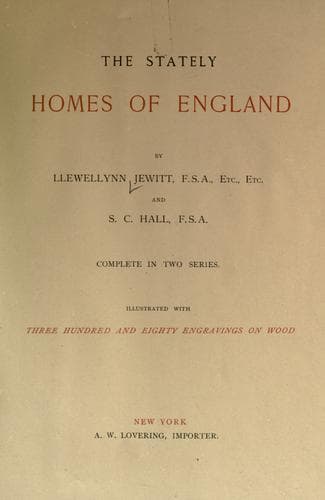
The Stately Homes of EnglandJewitt, Llewellynn Frederick William
History
The Stately Homes of England
Jewitt, Llewellynn Frederick William
Historic buildings -- England
The fortunate husband of this last heiress of the Percies, on the death
of his grandfather, Sir Hugh Smithson, in the year 1729, succeeded to
the baronetcy, which had been conferred by Charles II. in 1663 on that
grandfather’s grandfather, also a Hugh Smithson. A remarkably handsome
man, with a refined taste, and in many other respects well qualified
for the distinguished destiny which awaited him, Sir Hugh Smithson
is said to have been in no slight degree indebted for his eventual
splendid matrimonial success to a previous failure. He had attracted
the attention of Lady Percy, who, on hearing that some other lady had
rejected the suit of Sir Hugh Smithson, expressed her surprise that any
lady should have refused to accept such a man. The words of the fair
and noble heiress reached the ears of the disconsolate baronet, and
they promptly wrought a marvellous change in his views and aspirations.
Upon the hint so given Sir Hugh spoke, and—his words were not in
vain. In nearly all the “Peerages,” borrowed one from another, it is
stated that this Sir Hugh Smithson early in life went to London, where
he established himself in business as an apothecary. Although no slur
would thus have been cast on the illustrious race, it is simply untrue.
The following statement, extracted from a “Baronetage” published in
1727, may be accepted in proof:—
“The present Sir Hugh Smithson married a sister of the late Lord
Langdale, and had two sons, who lived to man’s estate. Hugh, the
eldest, died unmarried before his father; Langdale Smithson, the second
son, married Miss Revely, by whom he left only one son, Hugh—now a
minor, and a most hopeful young gentleman—so that there now remain
only two heirs to the title and estate—this young gentleman, Sir
Hugh’s grandson, and Hugh Smithson, of Tottenham, Esq., cousin of Sir
Hugh.”
[Illustration: _The East Garret._]
The “young gentleman” in question succeeded his grandfather as Sir
Hugh Smithson, of Stanwick. There was no trace in any documents
or papers of his ever having been in any position but that of the
acknowledged heir to a considerable estate and to a baronetage, granted
to his ancestor for his loyalty and sacrifices in the royal cause
during the civil wars of Charles I.[21] He married Lady Percy on the
16th of July, 1740, when he became Earl of Northumberland with all the
territorial greatness attendant on that earldom.
[Illustration: _The Garden Gate, or Warder’s Tower._]
Public-domain text, read in full here on John Shaqi.
Reviews
Reviews
No reviews yet
Be the first to share your thoughts on this work.
Elsewhere in the archive
Join the Discussion
Join the discussion
Sign in to leave a comment or review.
Sign InorCreate an account